
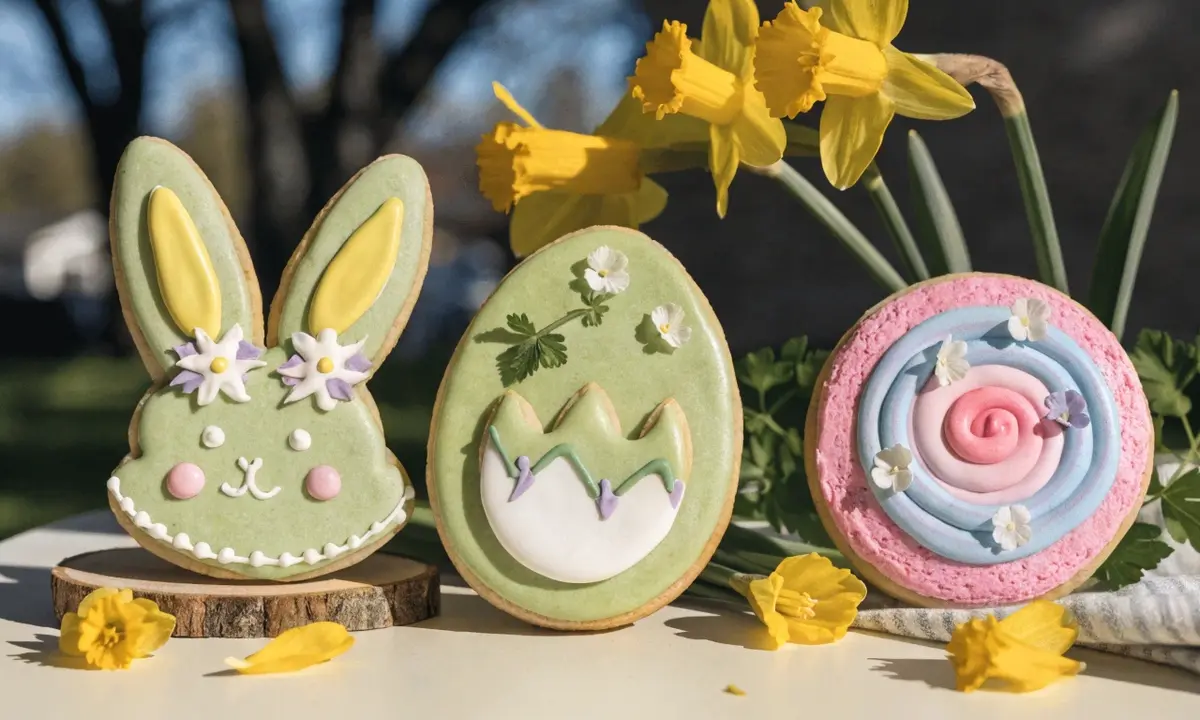
Author’s note: I tested the pastel icing colors below with both gel and natural food coloring side by side — the natural version needed roughly double the drops to reach the same softness, which is the opposite of what most bakers expect.
Spring Means Two Things: Pastels and Brightness
Easter cookies live at the intersection of soft color and bright, citrusy or coconut-forward flavor — a contrast to the deep chocolate and warm spice flavors that dominate the rest of the year on this site. This guide gives two full recipes (lemon shortbread and coconut nest cookies), then a shorter roundup of five more ideas.
Recipe 1: Lemon Shortbread Cookies
Extract, Zest, or Both?
Lemon flavor in baking comes from three sources that aren’t interchangeable. King Arthur’s baking team breaks it down clearly: zest gives the most aromatic lemon flavor, fresh juice gives tart acidity, and extract gives concentrated lemon flavor without the tartness. For a shortbread where you don’t want extra liquid or excess tartness throwing off the dough’s texture, that makes extract and zest the two to combine — juice is better saved for a glaze, where a little acidity helps balance the sweetness.
Yields: 16 cookies Prep time: 20 minutes (plus 20 minute chill) Bake time: 12–14 minutes
Ingredients:
- 226 g unsalted butter, softened
- 130 g powdered sugar
- 1 tbsp lemon zest (about 1 large lemon)
- 1/2 tsp lemon extract
- 280 g all-purpose flour
- 1/4 tsp fine sea salt
Lemon glaze:
- 120 g powdered sugar
- 2–3 tbsp fresh lemon juice
- Pastel yellow gel food coloring (optional)
Method:
- Cream butter and powdered sugar until light, then beat in lemon zest and extract.
- Fold in flour and salt just until combined.
- Roll to 1/4-inch thickness between parchment, chill 20 minutes, and cut into simple rounds or flower shapes.
- Bake at 325°F (165°C) for 12–14 minutes until edges are just barely golden.
- Cool completely, then whisk glaze ingredients together and drizzle or dip.
Recipe 2: Coconut Nest Cookies
A simple coconut-oat cookie shaped into a nest and filled with three pastel candy eggs — visually the most distinctly “Easter” cookie on this list.
Yields: 12 cookies Prep time: 20 minutes Bake time: 11–13 minutes
Ingredients:
- 170 g unsalted butter, softened
- 150 g brown sugar, packed
- 100 g granulated sugar
- 1 large egg
- 1 tsp vanilla extract
- 200 g all-purpose flour
- 1/2 tsp baking soda
- 1/4 tsp fine sea salt
- 120 g sweetened shredded coconut, plus extra for rolling
- 80 g rolled oats
- Malted milk chocolate eggs, for filling
Method:
- Cream butter and both sugars, then beat in egg and vanilla.
- Fold in flour, baking soda, and salt, then fold in coconut and oats.
- Portion 60 g balls, roll in extra shredded coconut, and press a deep well into the center of each with your thumb or the back of a spoon.
- Bake at 350°F (175°C) for 11–13 minutes; re-press the center well immediately out of the oven while still soft, since it will partially puff back during baking.
- Once fully cool, nestle 2–3 malted milk chocolate eggs into each well.
5 More Easter Cookie Ideas
- Carrot Cake Cookies: A spiced, shredded-carrot cookie topped with cream cheese frosting — Easter’s answer to the classic cake.
- Robin’s Egg Speckled Cookies: A pale blue sugar cookie base with cocoa-powder “speckles” dusted on before baking.
- Hot Cross Bun Cookies: Warm spiced cookies with dried currants and a simple piped icing cross on top.
- Carrot Patch Cookies: Orange-tinted shortbread cut into carrot shapes with a green icing top.
- Pastel Funfetti Cookies: A vanilla sugar cookie base loaded with pastel sprinkles instead of the usual rainbow mix.
Getting Soft Pastel Colors Right
The instinct with pastel colors is to under-color, but the bigger mistake actually goes the other way depending on which type of coloring you use. Gel food coloring is so concentrated that a single drop can push past pastel into a saturated shade quickly, so add it one drop at a time, mixing fully between each. Natural, plant-based food colors behave in the opposite direction: King Arthur’s guide to cookie decorating with natural colors notes that natural colors are less concentrated than synthetic gel pastes, so they typically need more drops to reach the same depth of color. Know which type you’re using before you start adding drops, since the “go slow” advice that works for gel can leave a natural-colored icing looking barely tinted.
Troubleshooting
| Problem | Likely Cause | Fix |
|---|---|---|
| Lemon shortbread tastes flat | Extract omitted, relying on zest alone | Add the extract — zest alone is more aromatic than flavorful |
| Coconut nests lose their well shape | Center not re-pressed right out of the oven | Press again immediately while cookies are still soft, before they set |
| Pastel icing turned out too saturated | Used gel color at full-strength drops | Dilute a single drop in a small amount of water first, then add gradually |
| Pastel icing looks barely tinted | Used natural food color at gel-color drop counts | Add roughly double the drops compared to gel color |
Storage
| Method | Time | Notes |
|---|---|---|
| Lemon shortbread, glazed | 1 week | Airtight, room temperature |
| Coconut nests, filled | 4 days | Chocolate eggs soften if stored too warm |
| Unfilled coconut cookies | 1 week | Fill with candy eggs just before serving |
| Frozen dough (either recipe) | 3 months | Thaw in the fridge before baking |
FAQ
Can I use bottled lemon juice instead of fresh for the glaze?
Fresh is noticeably better here since the glaze has so few ingredients to hide bottled juice’s flatter flavor, but bottled will work in a pinch.
What can I use instead of malted milk eggs in the coconut nests?
Any small pastel or foil-wrapped chocolate candy works — mini chocolate eggs, jelly beans, or speckled chocolate eggs are all common substitutes.
Do I need a candy thermometer for any of these recipes?
No — neither recipe involves cooked sugar work, unlike the caramel or royal-icing-heavy recipes elsewhere on the site.
Can I make the lemon shortbread dairy-free?
Yes, a straight swap to a vegan butter substitute works well in a shortbread like this one, since there’s no egg to also replace.
Sources Cited
- King Arthur Baking — Beyond Juice: All the Ways You Can Bake with Lemon (extract vs. zest vs. juice)
- King Arthur Baking — Cookie Decorating with Natural Food Colors (natural vs. gel coloring concentration)
Read also :
- /conversation-heart-cookies/ — royal icing technique reference
- /seasonal-cookie-flavors/ — pillar page
Leave a Reply