
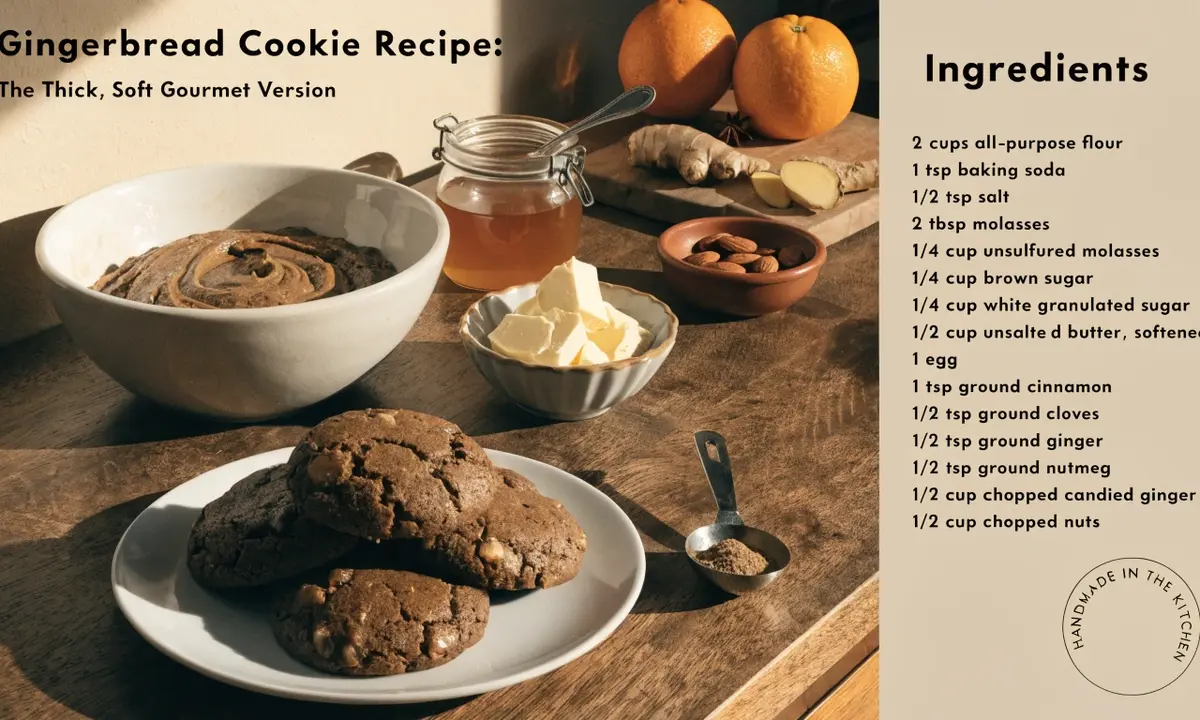
Most gingerbread cookies are thin, crisp, and built for decorating — the kind you roll flat, cut into shapes, and glaze with royal icing. They are wonderful, but they are not the gingerbread this guide is about. This is the thick version: a large, pillowy drop cookie with a soft, fudgy center, deep molasses color, and enough spice to fill a room when it comes out of the oven. Closer to a gourmet bakery cookie than a Christmas cut-out. Finished with a thick swirl of tangy cream cheese frosting that plays against the bittersweet molasses base.
According to King Arthur Baking’s gingerbread research, the difference between a flat, crisp gingerbread and a thick, soft one comes down to three variables: flour ratio, fat type, and chilling time. Get those three right and the texture follows. This guide covers all three in detail — plus the spice blend, the molasses selection, and the cream cheese frosting that makes this cookie worth the effort.
This article is part of the seasonal cookie flavors guide and builds on the flavor introduction in our 10 gourmet Christmas cookie flavors overview.
What makes this the gourmet version
Brown butter instead of standard softened butter · Fresh ginger alongside ground ginger · Blackstrap molasses for depth, not regular molasses · A 24-hour dough rest for developed flavor · Cream cheese frosting finish rather than royal icing glaze
The Recipe
Ingredients — Makes 10–12 large cookies
Cookie dough
- 225g (1 cup / 2 sticks) unsalted butter
- 200g (1 cup) dark brown sugar, packed
- 100g (⅓ cup) blackstrap molasses
- 1 large egg + 1 egg yolk, room temp
- 2 tsp pure vanilla extract
- 1 tbsp fresh ginger, finely grated
- 360g (3 cups) all-purpose flour
- 1½ tsp baking soda
- ½ tsp fine sea salt
- 2 tsp ground ginger
- 2 tsp ground cinnamon
- ½ tsp ground cloves
- ½ tsp ground nutmeg
- ¼ tsp ground black pepper
Cream cheese frosting
- 225g (8 oz) full-fat block cream cheese, cool room temp
- 115g (½ cup / 1 stick) unsalted butter, cool room temp
- 360g (3 cups) powdered sugar, sifted
- 1 tsp pure vanilla extract
- ¼ tsp ground cinnamon
- Pinch of fine sea salt
Optional garnish
- Flaky sea salt (Maldon or fleur de sel)
- Candied ginger pieces
- Cinnamon sugar dusting
Method
1
Brown the butter
Melt butter in a light-colored saucepan over medium heat, stirring frequently. Once melted, continue cooking 4–6 minutes until the milk solids turn golden and the butter smells nutty. Pour immediately into a large mixing bowl and cool to room temperature (about 30 minutes). Do not refrigerate to speed this up — the butter needs to be soft and pourable, not solid.
2
Combine wet ingredients
Whisk cooled brown butter with dark brown sugar and blackstrap molasses until smooth, about 2 minutes. Add the egg, egg yolk, vanilla extract, and fresh grated ginger. Whisk vigorously until fully combined and slightly lightened in color, about 1 minute. The mixture should look uniform with no streaks of sugar.
3
Add dry ingredients
In a separate bowl, whisk together flour, baking soda, salt, and all ground spices. Add dry ingredients to the wet all at once. Fold with a rubber spatula until just combined — no dry streaks remaining, but do not overmix. The dough will be soft and slightly sticky.
4
Chill — minimum 2 hours, ideally overnight
Cover the bowl tightly and refrigerate for at least 2 hours. Overnight (8–24 hours) produces noticeably better flavor as the spices bloom and the molasses flavor deepens. The dough will firm up significantly and become easy to scoop. Do not skip this step — un-chilled gingerbread dough spreads flat.
5
Preheat and scoop
Preheat oven to 375°F / 190°C. Verify with an oven thermometer. Line baking sheets with parchment. Using a #16 disher scoop, portion dough into balls (approximately 60g each). Place 6 per half-sheet pan. Press each ball into a disc about 2cm thick with the flat bottom of a glass or measuring cup.
6
Bake
Bake 10–12 minutes. The edges should look set and the surface matte, but the center should still appear slightly underdone — it will firm up during the pan rest. Do not bake until the center looks fully set; that cookie will be hard by the time it cools. Rest on the pan 10 minutes before transferring to a wire rack to cool completely before frosting.
7
Make the cream cheese frosting
Beat cream cheese and butter together on medium speed until smooth and combined, about 2 minutes. Do not beat on high — overmixing introduces too much air, which makes the frosting unstable. Add sifted powdered sugar in two additions, beating on low between each, then add vanilla, cinnamon, and salt. Beat on medium until just smooth. If too soft to pipe, refrigerate 15–20 minutes. Apply with an offset spatula or pipe with a 1M star tip.
Ingredient Decisions That Make the Biggest Difference
Blackstrap vs. regular molasses
Molasses comes in three grades, each with a different flavor intensity. Mild (light) molasses is the sweetest and least complex. Dark (robust) molasses has more bitterness and depth. Blackstrap molasses is the most concentrated — it is the liquid left after the maximum amount of sugar has been extracted from the cane, giving it the deepest, most bittersweet, almost mineral character.
For thick gourmet gingerbread cookies, blackstrap is the right choice. Its intensity holds up against the cream cheese frosting and provides the characteristic deep color. Using mild molasses produces a paler, sweeter cookie that reads more like a soft spice cookie than a true gingerbread. According to Serious Eats’ gingerbread testing, blackstrap molasses consistently produced the most complex, deeply flavored result across all test batches.
Fresh ginger vs. ground ginger — and why you need both
Fresh and ground ginger are not interchangeable in this recipe — they provide different flavor profiles that together create a more complete ginger experience than either alone. Fresh ginger is bright, sharp, and slightly grassy with a quick, clean heat. Ground ginger is warmer, more earthy, and produces a slower, lingering heat. The combination gives the cookie both immediate brightness and a sustained warmth that builds.
Grate fresh ginger on a microplane — the fine texture integrates into the dough rather than leaving fibrous chunks. Use the frozen ginger technique if you bake gingerbread regularly: freeze a knob of fresh ginger and grate it directly from frozen. It grates more finely and cleanly than room-temperature ginger.
Black pepper in the spice blend
The ¼ teaspoon of black pepper in this recipe is not a mistake. Black pepper appears in traditional German pfeffernüsse and Scandinavian pepparkakor gingerbread recipes for a specific reason: piperine, the active compound in black pepper, provides a distinct warmth that amplifies and extends the heat of ginger. At this quantity it is not identifiable as “pepper flavor” — it simply makes the overall spice blend taste more complex and warming.
Brown butter vs. softened butter
Standard gingerbread recipes use softened butter creamed with sugar. This recipe uses browned butter combined with sugar — no creaming step — for two reasons. First, brown butter’s nutty Maillard compounds add a caramel depth that plays well against molasses. Second, since browned butter is melted and then cooled rather than creamed, the dough has a slightly different structure — it rests more naturally into a dense, fudgy crumb rather than the airier texture that creaming produces. For thick, soft gingerbread cookies, this denser structure is exactly right.
Troubleshooting
| Problem | Likely cause | Fix |
|---|---|---|
| Cookies spread flat | Dough not chilled enough, butter too warm | Chill minimum 2 hours; ensure brown butter cooled fully before mixing |
| Cookies too dry / crumbly | Too much flour or overbaked | Weigh flour; pull from oven when center still looks underdone |
| Flavor too bitter | Too much blackstrap molasses or burnt brown butter | Measure molasses precisely; watch butter closely — golden, not dark brown |
| Frosting too runny | Cream cheese or butter too warm | Refrigerate frosting 20 min before applying; ensure cookies are fully cooled |
| Spice flavor too faint | Old ground spices losing potency | Replace ground spices older than 12 months; bloom in warm brown butter before mixing |
A Note on Spice Freshness
Ground spices lose potency rapidly. Most home spice collections contain jars that are 2–3 years old, which produce a fraction of the flavor of fresh spices. For a cookie where the spice blend is the entire point, this matters enormously. The Kitchn’s spice guide recommends replacing ground spices every 6–12 months and whole spices every 2–3 years.
A simple freshness test: open the jar and smell immediately after opening. Fresh ground cinnamon should be powerfully fragrant — if you have to bring the jar close to your nose to smell anything, the spice is past its useful life. Replace spices before baking gingerbread, not after wondering why the flavor was underwhelming.
Where possible, buy whole spices and grind them fresh — a small coffee grinder dedicated to spices works perfectly. Whole nutmeg grated directly onto a microplane is dramatically more aromatic and flavorful than pre-ground nutmeg. The difference is particularly noticeable in gingerbread where nutmeg is a supporting but important note.
How to bloom spices for maximum flavor
After browning the butter, let it cool for 5 minutes — it should still be warm but not hot. Whisk the ground spices directly into the warm brown butter before adding the sugar and molasses. The fat-soluble aromatic compounds in the spices dissolve more fully into warm fat than into the dough directly, intensifying and distributing flavor throughout the cookie more evenly. This technique is borrowed from Indian cuisine’s tadka method and produces a noticeably more aromatic gingerbread.
Variations Worth Trying
Gingerbread with lemon cream cheese frosting
Add 1 tablespoon of fresh lemon zest and 1 teaspoon of lemon juice to the cream cheese frosting. The citrus brightness cuts through the richness of the molasses base and creates a more complex flavor contrast than vanilla frosting alone. A classic pairing in Scandinavian baking traditions where ginger and citrus appear together frequently.
Salted caramel stuffed gingerbread
Flatten each dough ball, place a frozen disc of salted caramel (made from store-bought caramel sauce poured into an ice cube tray and frozen) in the center, and wrap the dough around it. Bake as normal — the caramel melts into the center, creating a molten core. The salt in the caramel amplifies the molasses flavor significantly.
Vegan adaptation
Replace butter with vegan stick butter (same quantity — do not brown it). Replace egg and egg yolk with 1 flax egg (1 tbsp ground flaxseed + 3 tbsp water, rested 5 minutes) plus 1 tablespoon of aquafaba. The strong spice flavors and molasses mask most of the flavor difference between vegan and dairy butter in this recipe. Vegan cream cheese (Violife block-style) produces a workable frosting at the same ratios.
Storage and Make-Ahead Guide
🗓️
Dough
Fridge: up to 72 hrs
Freezer: up to 3 months
Bake from frozen +4 min
🍪
Baked, unfrosted
Room temp: 2 weeks
Freezer: 3 months
Gets better day 2–3
🎂
Frosted
Fridge: 4–5 days
Room temp: 2 hrs max
Serve slightly chilled
Frequently Asked Questions
Can I make this recipe without molasses?
Not if you want gingerbread — molasses is what makes gingerbread gingerbread. The closest substitute is dark treacle (used in British recipes) at a 1:1 ratio. Honey or maple syrup change the flavor profile completely and produce a lighter, sweeter cookie that is excellent but not gingerbread.
Why does gingerbread taste better the next day?
Two reasons. First, the spice flavors continue to bloom and meld as the cookie rests — the same phenomenon that makes curries and stews taste better reheated. Second, the moisture from the molasses redistributes through the crumb overnight, softening any slightly dry edges and making the entire cookie more evenly tender. Gingerbread on day two is almost always better than on day one. Bake the day before if you can.
Can I use this dough for cut-out gingerbread cookies?
This dough is too soft for rolling and cutting — it is formulated for a thick drop cookie with a fudgy crumb, not a sturdy cut-out. For decorating-style gingerbread, you need a different recipe with more flour, less fat, and no brown butter (which makes dough stickier and harder to roll). The King Arthur Baking cut-out gingerbread recipe is the benchmark for that style.
How do I get the spice blend right for my taste?
The spice blend in this recipe produces a balanced, assertively spiced cookie. To adjust: more cinnamon = warmer and sweeter; more ginger (both fresh and ground) = sharper, hotter; more cloves and black pepper = deeper, more complex warmth; more nutmeg = earthier and floral. The safest adjustment is to make the recipe as written first, taste the raw dough (before adding egg if safety is a concern), and adjust the spice ratios in a second batch based on your preference.
Continue reading — Seasonal Cookie Flavors
- Christmas Cookie Recipes: 10 Gourmet Flavors for Your Holiday Cookie Tray
- Peppermint Mocha Cookies: A Holiday Coffee-Shop Favorite at Home — coming soon
- Eggnog Cookie Recipe: Capturing the Holiday Drink in Cookie Form — coming soon
- Sugar Cookie Recipe for Decorating: Holds Shape, Tastes Great — coming soon
- ← Back to Seasonal Cookie Flavors: A Year-Round Baking Guide
Leave a Reply