
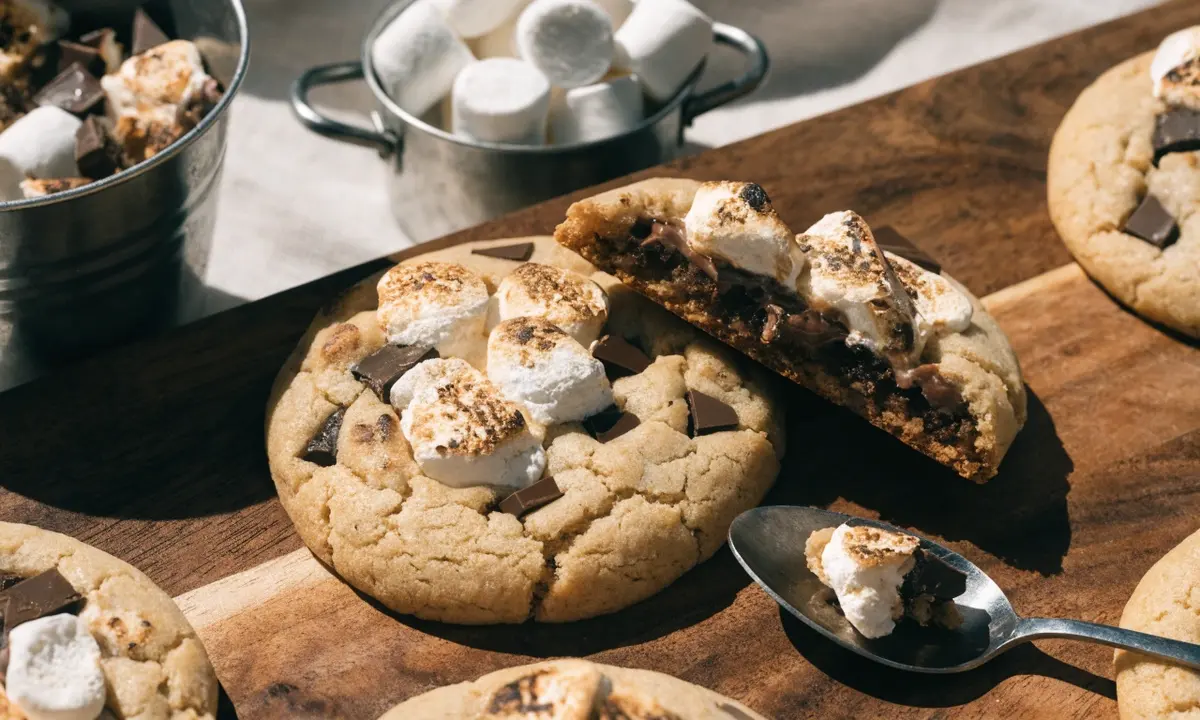
Author’s note: My first batch went in with marshmallows from the start and came out with scorched, deflated tops before the cookie itself had even finished baking. The two-stage method below fixed it completely.
The Marshmallow Timing Problem
Marshmallows and cookie dough don’t bake on the same clock. A cookie needs 10–12 minutes to set properly, but a marshmallow only needs 2–4 minutes to toast before it scorches — put both in the oven together from the start and you’ll get a burnt marshmallow sitting on an underbaked cookie.
The fix is a two-stage bake: bake the cookie mostly through first, then add the marshmallow topping only for the final few minutes. This mirrors how other s’mores-style recipes handle the same problem — King Arthur’s own s’mores granola bars are baked first without the marshmallow, which goes on top afterward for just a few minutes under the broiler until toasted, specifically to avoid over-browning it. This cookie recipe uses the same two-stage logic.
Full Recipe
Yields: 12 large cookies Prep time: 20 minutes Bake time: 13–16 minutes total (two stages)
Dough
- 226 g unsalted butter, softened
- 150 g brown sugar, packed
- 100 g granulated sugar
- 1 large egg
- 1 tsp vanilla extract
- 260 g all-purpose flour
- 80 g graham cracker crumbs
- 1/2 tsp baking soda
- 1/4 tsp fine sea salt
- 150 g chocolate bar, roughly chopped (chunks, not chips)
- 12 large marshmallows, halved
6-Step Method
- Cream and combine. Beat butter and both sugars until fluffy, then beat in egg and vanilla.
- Add graham flour blend. Whisk flour, graham cracker crumbs, baking soda, and salt separately — the crumbs stand in for part of the flour and are what give the dough its signature graham flavor. Fold into the wet mixture.
- Fold in chocolate chunks. Use a chopped chocolate bar rather than chips — bar chocolate melts into irregular pools that read more like a “real” s’more than uniform chocolate chips do.
- First bake. Portion 90–100 g dough balls, bake at 350°F (175°C) for 10–12 minutes until the edges are set but the center still looks slightly underdone.
- Add marshmallow, second bake. Remove cookies from the oven, immediately press 2 marshmallow halves cut-side-down onto the top of each, and return to the oven for 3–4 minutes until the marshmallows are puffed and just beginning to turn golden.
- Watch closely and cool. Marshmallows go from perfectly toasted to burnt quickly in this final stage — stay near the oven. Cool at least 10 minutes before eating; the marshmallow center stays extremely hot.
Why Graham Cracker Crumbs Belong in the Flour, Not Just on Top
Mixing crushed graham crackers directly into the dry ingredients — rather than only using whole crackers as a base or garnish — changes the texture and flavor of the entire cookie rather than concentrating graham flavor in one spot. This is the same logic behind bakery-style s’mores cookie recipes that fold crushed crackers straight into the flour for a toasted, honey-wheat flavor running through the whole cookie, rather than treating graham as a separate component.
Optional: A Toasted, Torched Finish
For a more visibly “campfire” marshmallow finish rather than an oven-toasted one, a kitchen torch can be used on the marshmallow halves after the second bake for a few extra seconds of direct, spotty charring — this is optional and purely cosmetic, since the oven method already fully toasts the marshmallow.
Troubleshooting
| Problem | Likely Cause | Fix |
|---|---|---|
| Marshmallows burned before cookie finished baking | Added marshmallow at the start instead of using the two-stage bake | Bake the cookie mostly through first, then add marshmallow for the final few minutes only |
| Graham flavor is weak | Used too little crumb, or coarse crumbs | Pulse crumbs finer in a food processor; don’t skimp on the amount |
| Cookies spread too thin | Butter too warm when mixed | Use butter that’s soft but still cool to the touch, not melted |
| Chocolate seized into hard clumps instead of melty pools | Used chocolate chips instead of a chopped bar | Chop a baking bar for irregular pieces that melt more generously |
Storage
| Method | Time | Notes |
|---|---|---|
| Room temperature, airtight | 2 days | Marshmallow topping hardens and dries out faster than the cookie itself |
| Reheated | Best fresh | A 10-second microwave zap or a few minutes in a 350°F oven revives the melty texture |
| Frozen dough (unbaked, no marshmallow) | 3 months | Bake fresh and add marshmallow at the second-stage step |
| Frozen, fully baked | Not recommended | Marshmallow texture suffers badly on thawing |
FAQ
Can I use mini marshmallows instead of large ones, halved?
Yes — scatter 4–5 mini marshmallows per cookie instead of the halved large ones; they toast slightly faster, so watch the second bake closely.
Do I need a broiler for the marshmallow step?
No, a standard 350°F bake for the second stage works fine and is easier to monitor than a broiler, which can go from toasted to burnt in seconds.
Can I make these without the graham cracker crumbs in the dough, using them only as a base?
Yes, though the graham flavor will be more concentrated in one bite rather than running through the whole cookie — both approaches are valid depending on preference.
Why don’t these use freeze-dried strawberry the way other summer recipes on this site do?
S’mores flavor doesn’t call for fruit — its color and identity come from chocolate, graham, and toasted marshmallow rather than the fruit-forward approach used in the strawberry shortcake cookies or key lime cookies.
Read Also
- Strawberry Shortcake Cookie Recipe for Summer — related summer flavor
- Seasonal Cookie Flavors: A Year-Round Baking Guide — pillar page
Sources Cited
- King Arthur Baking — S’more Granola Bars Recipe (two-stage bake, marshmallow timing)
- Baker Recipes — Smores Cookies in 25 Minutes (graham cracker flour technique)
Leave a Reply