
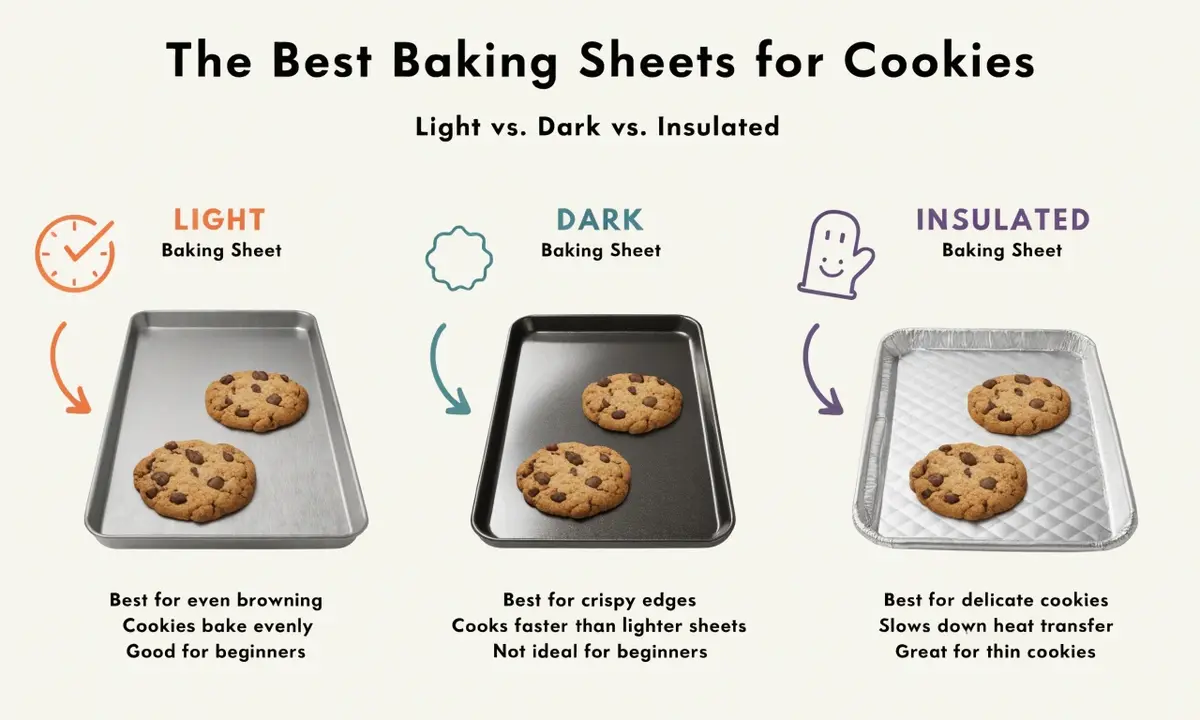
Not all cookie sheets bake the same cookie. Swap a dark nonstick pan for a light aluminum one using the exact same dough and oven, and you’ll usually get a darker-looking bottom with less even spread. Pan material and color change how quickly heat moves from the oven into the dough, and that has a bigger effect on your finished cookie than most bakers expect.
Why Pan Color and Material Matter
Baking sheets don’t just hold cookies, they conduct heat. Metal color and thickness determine how much radiant heat a pan absorbs and how fast it passes that heat into the dough sitting on top of it. A pan that heats up quickly and holds that heat will brown a cookie’s bottom faster than the center and edges can catch up, while a pan that heats more gradually gives a cookie time to set evenly before the bottom over-bakes.
Light Aluminum Pans
Light-colored, uncoated aluminum is the standard recommendation for cookie baking. Aluminum reflects a larger share of the oven’s radiant heat rather than absorbing it, so the pan heats more gradually and transfers heat to the dough at a steadier rate. The practical result is a bottom that browns in step with the top and edges instead of racing ahead of them. Heavier-gauge aluminum, 18-gauge is the common benchmark, also resists warping at high heat, which keeps the pan flat instead of buckling into hot spots.
Dark and Nonstick-Coated Pans
Dark pans, including most dark nonstick sheets, absorb radiant heat aggressively. The metal gets hotter than a light pan would at the same oven temperature, and it transfers that heat to the cookie bottom faster. For thin cookies this can shave a minute or two off bake time, but for thicker, Crumbl-style cookies it more often shows up as a bottom noticeably darker than the top before the center has fully set. Dark pans also tend to hold heat longer between trays, which matters when baking multiple batches back to back.
Insulated (Air-Cushion) Pans
Insulated sheets sandwich a layer of air between two thin metal layers, which slows heat transfer to the cookie bottom significantly. That makes them useful in narrow situations, such as a home oven that runs hot or a dark pan being the only one available, but the insulation works both ways: it also slows browning on the bottom of cookies that need it, and can leave the underside pale or slightly underbaked even when the top and edges look done. For most bakers, a light aluminum pan gives more control than an insulated one, since oven temperature is easier to adjust than a pan’s built-in insulation.
Quick Comparison
- Light aluminum (uncoated): gradual, even heat transfer. Best for most cookie recipes, especially thick, Crumbl-style dough. Watch for thinner sheets warping, so choose 18-gauge or heavier.
- Dark or dark nonstick: fast, aggressive heat absorption. Best for thin cookies where faster browning is welcome. Watch for over-browned bottoms on thick cookies; shorten bake time or lower oven temperature by about 25°F.
- Insulated / air-cushion: slow, buffered heat transfer. Best for very hot ovens or high-altitude baking. Watch for pale, underbaked bottoms; not needed for most home ovens.
Verdict
For the vast majority of home bakers making thick, Crumbl-style cookies, a heavy-gauge light aluminum half-sheet pan is the right default choice, and it’s a purchase that lasts for years rather than one you’ll need to replace as your baking improves. Dark pans aren’t wrong, they just require more attention: watch bottoms closely and consider dropping the oven temperature by about 25°F to compensate. Insulated pans are a narrow fix for a narrow problem, not a general upgrade.
How to Tell if Your Pan Is the Problem
If you’re not sure whether your baking sheet is affecting your results, run a simple side-by-side test: bake the same batch of dough on two different pans, on the same oven rack, and compare the bottoms once they’ve cooled. If one batch has noticeably darker or harder bottoms while the tops and edges look the same as the other batch, the pan is the variable, not the recipe. This kind of repeatable difference is exactly what shows up in professional testing: America’s Test Kitchen baked hundreds of cookies across different pan materials and finishes and found the differences in bottom browning were consistent from batch to batch, not a one-off fluke.
Common Questions About Cookie Sheets
Can I fix a dark pan without buying a new one?
Partially. Lowering your oven temperature by 20 to 25°F and lining the pan with parchment paper both reduce a dark pan’s tendency to over-brown cookie bottoms. Neither fully replicates a light aluminum pan, but together they close most of the gap.
Do I need to buy pans in pairs?
For anyone baking more than one tray at a time, yes. Having a second pan lets one cool completely while the next batch bakes, which matters because dough spreads differently on a warm pan than on a room-temperature one.
Are expensive baking sheets worth it?
Not necessarily. In Serious Eats‘ testing, the standout pick across multiple rounds was the Nordic Ware Naturals Half Sheet, which runs about $20 to $33 for a set of two, well below premium stainless-steel options that didn’t outperform it for cookie baking specifically.
Does pan size matter for Crumbl-style cookies?
Yes. A standard half-sheet pan (18″ x 13″) fits 6 to 9 large, Crumbl-style cookies with the 2 to 3 inches of spacing they need to spread properly without merging into each other.
How long do aluminum baking sheets actually last?
A heavy-gauge aluminum half-sheet pan typically lasts a decade or more with normal home use, since aluminum doesn’t rust and the natural finish has no coating that can chip or wear off. The main sign of aging is warping from repeated high-heat cycles or from being taken from oven to cold water, so let pans cool naturally instead of rinsing them hot. Discoloration and staining are cosmetic and don’t affect performance.
This article is part of our full cluster of in-depth equipment guides supporting our main equipment pillar page.
Read the full guide: Cookie Baking Equipment: The Complete Baker’s Guide
Leave a Reply