
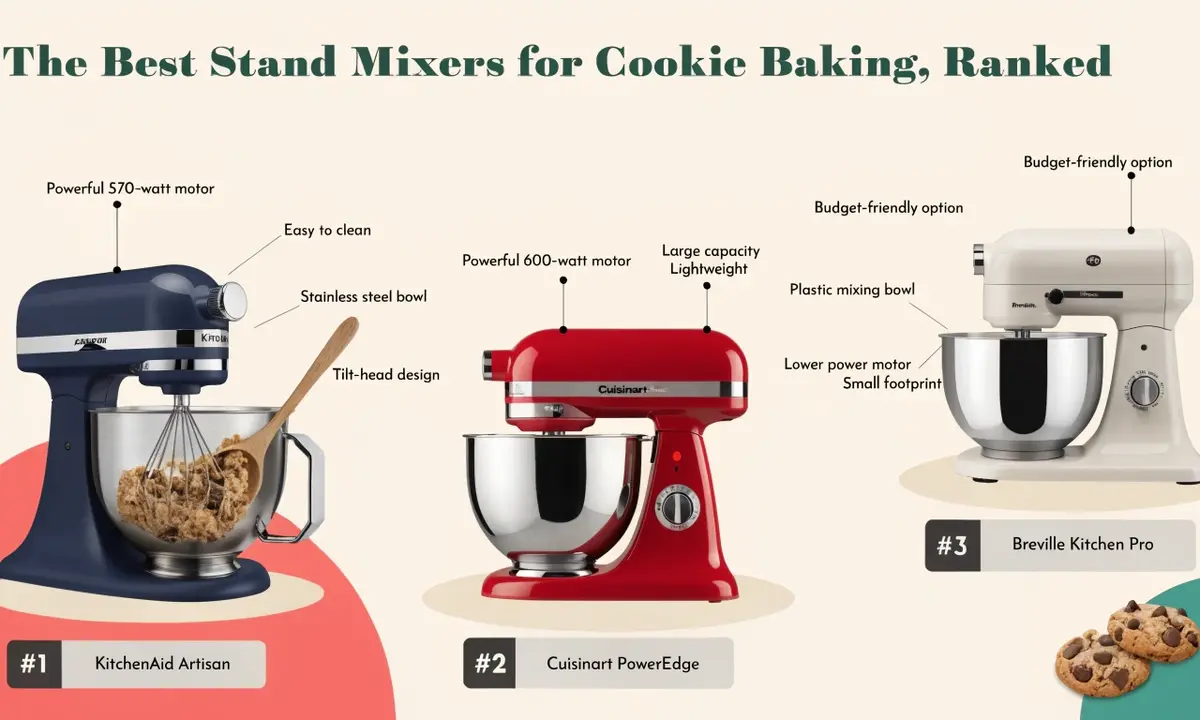
A stand mixer is the biggest equipment investment most home bakers make — and the most debated. The wrong choice means strained motors, stripped gears, and dough that climbs the hook while the bowl barely moves. The right choice runs quietly for decades through thousands of batches of stiff cookie dough without complaint. This guide ranks the best stand mixers specifically for cookie baking, based on the tasks that matter most: creaming butter and sugar, handling cold stiff doughs, and running long enough to develop proper texture without overheating.
Two articles in this cluster cover the context you need alongside this ranking: Stand Mixer vs. Hand Mixer for Cookie Dough explains when a stand mixer is actually necessary, and our complete cookie baking equipment guide covers every tool category that affects cookie outcomes.
What we evaluated
Motor power and sustained torque under load · Bowl capacity and usable volume · Creaming effectiveness at medium speed · Performance with stiff cold cookie dough · Noise level · Ease of cleaning · Long-term durability and parts availability · Value for money across price tiers
What Makes a Stand Mixer Good for Cookie Baking Specifically
Cookie baking stresses stand mixers differently than bread baking. Cookie dough — especially cold, stiff Crumbl-style dough with high butter and sugar content — requires sustained torque at medium speed rather than the slow, grinding resistance of bread dough. The motor needs to maintain consistent speed without bogging down or overheating during a 4-minute creaming phase.
The flat beater (paddle) attachment does the work for cookies — not the dough hook. A mixer that excels at bread may still produce uneven results for cookies if the paddle attachment sits too high in the bowl, leaving unmixed butter at the bottom. Bowl shape matters too: a rounded bottom bowl reaches every part of the dough, while a flat-bottomed bowl can leave dry pockets near the edges.
The three things to assess for cookie-specific use:
- Paddle-to-bowl clearance: The beater should come within 3–5mm of the bowl bottom. Too much clearance means ingredients collect under the paddle and never get incorporated.
- Speed consistency under load: At medium speed (speed 4–6), the motor should maintain consistent RPMs even when working through cold, stiff butter. Cheaper motors bog down and slow significantly.
- Splatter control: During the early creaming phase, powdered sugar and flour can escape the bowl. A splash guard attachment or deep bowl profile matters for cleanliness.
The Best Stand Mixers for Cookie Baking, Ranked
#1 BEST OVERALL$449–$549
KitchenAid Professional 600 Series (6-Qt Bowl-Lift)
The KitchenAid Pro 600 is the benchmark for home cookie baking. The bowl-lift design provides structural rigidity that the tilt-head models lack under heavy loads — the bowl is locked in position during mixing, eliminating the flex that can occur when the tilt-head joint loosens with age. The 575-watt motor handles cold butter and double batches of thick cookie dough without straining. At speed 4–6, the motor maintains consistent RPMs through the full creaming cycle.
The 6-quart stainless bowl fits a double batch of most cookie recipes comfortably — a meaningful advantage for anyone baking Crumbl-style large-format cookies in quantity. The included flat beater has good bowl clearance on the Pro 600, though some bakers upgrade to the aftermarket flex edge beater that scrapes the bowl sides during mixing and eliminates the need to stop and scrape manually.
Strengths
Bowl-lift rigidity · Excellent motor consistency · 6-qt capacity for large batches · Decades-long parts availability · Quiet at medium speeds
Weaknesses
Price premium over tilt-head models · Heavier (29 lbs) · Splash guard sold separately
Best for: Bakers making large batches regularly, anyone baking Crumbl-style large-format cookies in volume, serious home bakers who want one machine that lasts a lifetime.
#2 BEST TILT-HEAD$349–$429
KitchenAid Artisan Series 5-Qt (Tilt-Head)
The Artisan is the most popular stand mixer sold in North America by a significant margin, and for most home bakers making standard-size batches, it is all the mixer they will ever need. The 325-watt motor handles creaming butter and sugar effectively and runs standard cookie batches without overheating. The tilt-head design makes it slightly easier to access the bowl and add ingredients during mixing than a bowl-lift model.
The limitation for serious cookie bakers: the tilt-head joint develops play over time, especially with heavy doughs. After several years of heavy use, the head can flex slightly during mixing, reducing contact between the paddle and the bowl bottom. This is repairable (a common KitchenAid fix) but is the primary durability concern. For someone making two to three batches of cookies per week, the Artisan is entirely adequate. For daily high-volume baking, the Pro 600’s bowl-lift is the more reliable long-term investment.
Strengths
Lower price than Pro 600 · Lighter (26 lbs) · Wide color range · Good for standard batch sizes · Easy attachment access
Weaknesses
Tilt-head flex under heavy loads · 5-qt bowl is snug for double batches · 325W motor can strain with very stiff cold dough
Best for: Bakers making one batch at a time, 2–4 times per week. Anyone who wants KitchenAid quality without the Pro 600 price.
#3 BEST VALUE$199–$249
Cuisinart SM-50 5.5-Qt Stand Mixer
The Cuisinart SM-50 is the most recommended stand mixer for bakers who want a genuine upgrade from a hand mixer without the KitchenAid price. The 500-watt motor is competitive with the Artisan and handles most cookie doughs without strain. The 5.5-quart bowl is slightly larger than the Artisan’s 5-quart, giving a little more headroom for larger batches.
The honest tradeoffs: the Cuisinart is louder than a KitchenAid at equivalent speeds, and the bowl coating can show wear over time if put in the dishwasher repeatedly. The 12-speed dial provides good incremental control for the creaming phase. America’s Test Kitchen has rated the SM-50 as a “recommended” pick — not their top choice, but a solid performer at its price point. For someone baking cookies once or twice a week who isn’t ready to spend $400+, it is the right choice.
Strengths
Best price-to-performance ratio · 500W motor · 5.5-qt bowl · 12 speeds · Splash guard included
Weaknesses
Noticeably louder than KitchenAid · Bowl coating wears if dishwashed · Fewer premium attachments available than KA ecosystem
Best for: Budget-conscious bakers who want a real stand mixer without paying KitchenAid prices. Good for 1–2 batches per week.
#4 UNDERRATED PICK$349–$399
Bosch Universal Plus
The Bosch Universal Plus is one of the most underrated stand mixers in the home baking market. It has a 6.5-quart bowl and a uniquely designed drive system where the motor drives from the bottom of the bowl rather than the top, allowing an uncommonly even mixing action that reaches every part of the dough. The 800-watt motor produces more torque than any other mixer in this price range.
For cookie baking specifically, the Bosch is exceptional at handling very stiff doughs — thicker than most stand mixers can manage without the motor struggling. The limitation is the attachment ecosystem: the Bosch does not have the extensive third-party attachment library that KitchenAid has built over decades. For someone whose primary use is baking (rather than pasta, ice cream, or other KitchenAid attachment-based applications), this is rarely a relevant limitation.
Strengths
800W motor — most powerful in class · Bottom-drive mixing action · 6.5-qt bowl · Exceptionally quiet for its power · Great for stiff doughs
Weaknesses
Limited attachment ecosystem · Less widely available in stores · Less intuitive speed dial than KA
Best for: High-volume cookie bakers who prioritize motor power and bowl capacity over attachment versatility. Excellent choice if you know you’ll push the mixer hard.
#5 BUDGET RUNNER-UP$129–$169
Hamilton Beach Eclectrics 7-Qt All-Metal Stand Mixer
The Hamilton Beach Eclectrics occupies the entry-level stand mixer space more convincingly than the cheap competitors that crowd this price point. The all-metal construction is unusual at this price; most sub-$150 stand mixers use plastic gearing that strips under stiff dough. The 7-quart bowl is the largest in this comparison, which makes it useful for large batches even if the 400-watt motor is less powerful than the other options here.
The honest limitation: this mixer works for standard cookie recipes at room-temperature butter. For very stiff cold doughs — the kind required for thick Crumbl-style cookies where dough needs to be chilled before mixing — the motor will struggle. If you bake from cold butter frequently, save for the Cuisinart SM-50 instead. If you let your butter come to room temperature before mixing (as most recipes specify), the Hamilton Beach is a reasonable entry point.
Strengths
All-metal construction at entry-level price · 7-qt bowl capacity · Tilt-head · Decent speed range
Weaknesses
Motor struggles with very stiff cold doughs · No upgrade path within brand ecosystem · Louder than higher-end options
Best for: Occasional bakers (once a week or less) who want a real stand mixer on a tight budget and primarily use room-temperature butter.
Quick Comparison: All Five Mixers at a Glance
| Mixer | Motor | Bowl | Type | Price | Cookie Rating |
|---|---|---|---|---|---|
| KitchenAid Pro 600 | 575W | 6 qt | Bowl-lift | $449–549 | ★★★★★ |
| KitchenAid Artisan | 325W | 5 qt | Tilt-head | $349–429 | ★★★★½ |
| Cuisinart SM-50 | 500W | 5.5 qt | Tilt-head | $199–249 | ★★★★ |
| Bosch Universal Plus | 800W | 6.5 qt | Bowl-drive | $349–399 | ★★★★ |
| Hamilton Beach Eclectrics | 400W | 7 qt | Tilt-head | $129–169 | ★★★ |
The Attachment Question: Flex Edge Beater vs. Standard Flat Beater
For KitchenAid users, the single best upgrade for cookie baking is the flex edge beater — an aftermarket flat beater with a silicone edge that continuously scrapes the bowl sides during mixing. Standard flat beaters require you to stop the mixer every minute or two to scrape down the bowl manually. The flex edge eliminates this step and produces more evenly creamed butter and sugar without interruption.
The flex edge beater is made by KitchenAid and is available for all tilt-head and bowl-lift models (sizes differ — confirm your bowl size before purchasing). At $30–40, it is the highest-impact accessory purchase you can make for cookie-specific baking.
One limitation: the flex edge beater is not ideal for very stiff doughs (like bread dough) where the silicone edge can flex too much and reduce contact. For cookie doughs — which are generally softer than bread doughs — it performs excellently.
Common Stand Mixer Mistakes That Affect Cookie Quality
Having the right mixer is only part of the equation. How you use it matters as much as which model you own.
- Starting at high speed: Always start at speed 1–2 and increase gradually. Starting at speed 6 with cold butter can strain the motor and, more practically, will spray ingredients out of the bowl.
- Under-creaming butter and sugar: Most cookie recipes require 3–4 minutes of creaming at medium-high speed (speed 6–8 on a KitchenAid) to properly incorporate air and lighten the butter. Stopping at 60–90 seconds because it “looks done” produces a denser cookie with less lift.
- Over-mixing after adding flour: Once flour hits the bowl, switch to speed 1–2 and mix only until no dry streaks remain — usually 20–30 seconds. Additional mixing develops gluten and produces a tough cookie. The stand mixer makes this mistake easy because it mixes efficiently even at low speeds.
- Not adjusting bowl height: KitchenAid tilt-head models have a height adjustment screw on the motor head that controls how close the beater comes to the bowl bottom. Check this periodically — the beater should just barely miss the bowl. If it’s too high, it won’t reach the butter that collects at the bottom during early mixing.
- Overloading the bowl: The usable capacity of any stand mixer bowl is roughly two-thirds of its stated volume. A “6-quart” bowl works correctly for about 4 quarts of dough. Overloading causes the dough to climb the beater and can strain the motor.
KitchenAid speed guide for cookie baking
Speed 1–2: Adding flour and dry ingredients, final mixing to just combine
Speed 2–4: Incorporating eggs and liquid ingredients, mixing add-ins (chips, nuts)
Speed 4–6: Initial creaming phase, first 2 minutes with butter and sugar
Speed 6–8: Main creaming phase, minutes 2–4 to lighten and aerate the mixture
Frequently Asked Questions
Is a KitchenAid really worth the price for cookie baking?
For bakers who make cookies more than twice a week, yes — the KitchenAid’s build quality, consistency, and parts availability make it genuinely worth the price compared to cheaper alternatives that may need replacing within 3–5 years. For occasional bakers (once a month), a hand mixer is adequate and a KitchenAid purchase is hard to justify on baking use alone.
What wattage do I need for thick cookie dough?
For standard cookie doughs at room-temperature butter, 300W is sufficient. For very stiff cold doughs — thick Crumbl-style dough that has been chilled, or doughs with a high proportion of mix-ins — 500W+ provides a meaningful safety margin against motor strain. The Cuisinart SM-50 (500W) handles most cookie applications comfortably.
Should I get a 5-quart or 6-quart KitchenAid?
For cookie baking specifically: 5-quart handles a standard recipe (24–30 large cookies) comfortably. 6-quart allows double batches without overflow. If you frequently bake in large quantities or want flexibility, the 6-quart is worth the extra cost. If you typically bake one batch at a time, the 5-quart is entirely sufficient.
Bowl-lift vs. tilt-head: which is better for cookies?
For most home bakers, the functional difference is minimal. Bowl-lift models are more structurally rigid and better for high-volume, frequent use with stiff doughs. Tilt-head models are slightly more convenient for adding ingredients. If you’re baking daily or in large quantities, bowl-lift. If you’re baking a few times a week for household use, tilt-head is fine.
Can I use a hand mixer instead of a stand mixer for Crumbl-style cookies?
Yes, with some adjustments. A good hand mixer (the Breville Handy Mix or Cuisinart HM-90S) handles creaming and egg incorporation well. The challenge is the 3–4 minute sustained creaming phase — your arm will fatigue before the butter reaches full aeration. Switch between hands if needed, and ensure the butter is at room temperature (not cold) to reduce the load on the motor.
The Verdict
For most home cookie bakers, the decision comes down to two options: the KitchenAid Artisan if you want the proven standard and bake several times a week, or the Cuisinart SM-50 if you want genuinely good performance at roughly half the price. The KitchenAid Pro 600 is the right choice if you bake frequently in large batches and want a machine that will last 20+ years without maintenance issues.
The Bosch Universal Plus deserves more attention than it gets — its motor power and mixing action are exceptional — but the limited attachment ecosystem makes it a specialist recommendation rather than a general one.
Whatever mixer you choose, the techniques you apply with it matter more than the brand on the side. Proper creaming time, correct speed progression, and stopping at the right moment after adding flour produce better cookies than any specific model.
Continue reading — Cookie Baking Equipment
Leave a Reply