
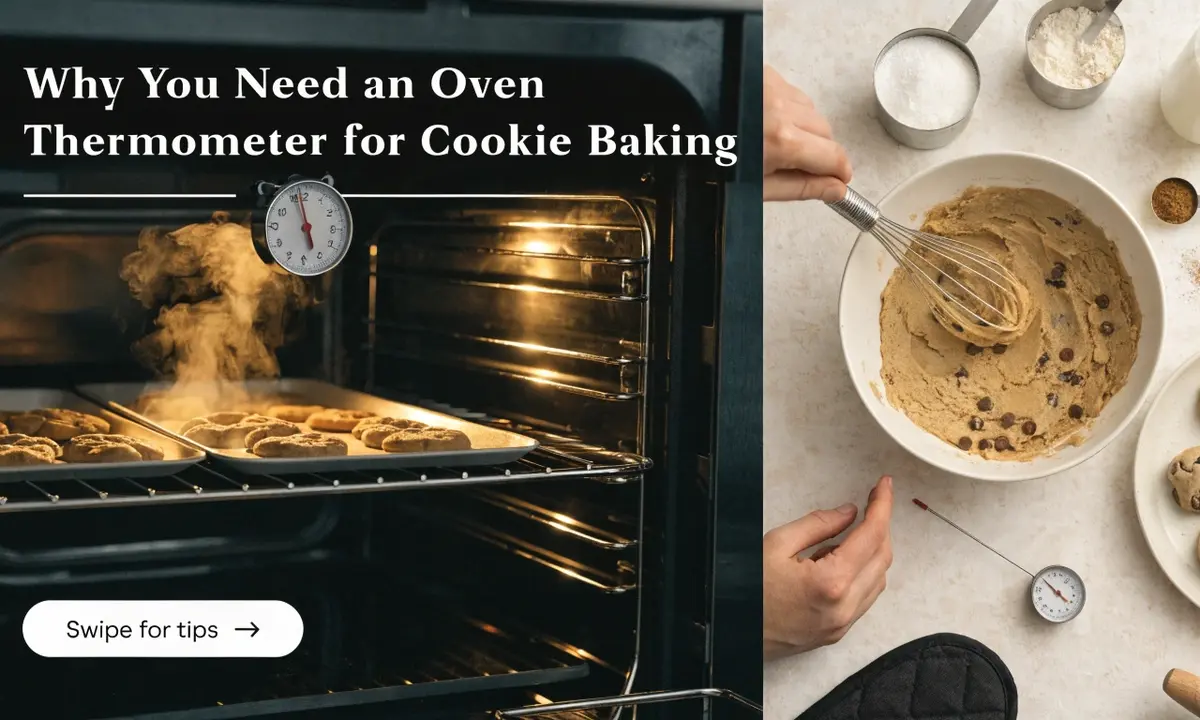
Your oven dial is lying to you. Not occasionally — consistently, and often by a significant margin. Independent testing by America’s Test Kitchen has found that the average home oven runs 25–50°F off its dial setting, and many run hotter or cooler depending on where in the oven cavity you measure. For roasting a chicken, a 30-degree variance is barely noticeable. For baking cookies — where the difference between 325°F and 375°F produces a fundamentally different product — it is the difference between a perfect batch and a pan of flat, greasy discs or burnt-bottom failures.
An oven thermometer costs between $7 and $25. It is the lowest-cost, highest-impact equipment addition available to a home baker — and it is the one tool that most home bakers skip. This article explains exactly why your oven’s temperature is probably wrong, what that means specifically for cookie baking, and how to use a thermometer to eliminate temperature as a variable in your results.
This article is part of our complete cookie baking equipment guide, which covers every tool that meaningfully affects cookie outcomes. For the broader picture of why equipment matters in thick cookie baking, that is the place to start.
The core problem in one sentence
Every cookie recipe is written and tested at a specific temperature. If your oven delivers a different temperature than the recipe specifies, you are not baking the recipe — you are baking a different recipe with different results.
Why Home Ovens Are Almost Never Accurate
A home oven uses a single thermostat — a bimetallic strip or electronic probe — to read the temperature and cycle the heating elements on and off. This system has several built-in sources of inaccuracy:
- Thermostat calibration drift: The thermostat that controls your oven was calibrated at the factory. Over time — especially with heavy use, temperature cycling, and the mechanical stress of heating and cooling — the calibration drifts. A new oven might be accurate to within 10°F. A five-year-old oven under daily use may be off by 50°F or more.
- Sensor placement: The oven’s temperature probe is mounted in one specific location inside the oven cavity — typically near the back wall. The temperature at that one point may not represent the temperature throughout the rest of the cavity, especially near the door, at the edges, or in the bottom third where most baking happens.
- Heating element cycling: Ovens don’t maintain a perfectly constant temperature — they overshoot during heating, then drop as the element cycles off, then reheat. The dial temperature is the target midpoint of this cycle, but during any given minute of baking, the actual temperature may be cycling 15–25°F above and below the target.
- Door seal degradation: The rubber seal around the oven door deteriorates with age, allowing heat to escape. An oven with a compromised door seal runs cooler than its dial indicates, with more dramatic temperature drops every time the door is opened.
According to Serious Eats’ extensive oven calibration testing, it is unusual to find a domestic oven that holds its stated temperature within 10°F throughout a baking session. Most fall in the 15–35°F variance range; poorly maintained or older ovens can exceed 50°F variance easily.
What Temperature Variance Actually Does to Your Cookies
Cookie baking is more temperature-sensitive than almost any other baked good. The reason is timing: a cookie goes from raw to done in 10–14 minutes. A roast that cooks for 90 minutes has time to average out temperature fluctuations. A cookie does not.
| Actual oven temp | Recipe calls for | Variance | What happens to the cookie |
|---|---|---|---|
| 310°F / 155°C | 350°F / 175°C | –40°F | Butter melts before structure sets — cookie spreads flat and grease pools around the edges. Pale, soft result with no defined edge. |
| 330°F / 165°C | 350°F / 175°C | –20°F | More spread than intended, less defined edges, slightly greasy texture. The cookie looks underbaked even when the recipe time is followed. |
| 350°F / 175°C | 350°F / 175°C | On target | Expected result — edges set correctly, centre remains soft, height is maintained. |
| 370°F / 188°C | 350°F / 175°C | +20°F | Edges set and brown faster than the centre rises. Cookie has crispy dark edges and a doughy centre that doesn’t fully bake in the stated time. |
| 390°F / 199°C | 350°F / 175°C | +40°F | Rapid caramelisation of the bottom surface. Cookie appears done on the outside at 10 minutes but is raw inside; bottom is dark to burnt. |
The food science publication Food Network’s baking science series notes that cookie dough spread is particularly temperature-sensitive because butter melts at approximately 90–95°F — well below baking temperature. The speed at which the oven heats the outer structure of the cookie relative to the speed at which the butter melts determines whether the cookie sets tall or spreads flat. A cooler oven tips this race toward spreading; a hotter oven tips it toward setting quickly.
Oven Hot Spots: The Problem Beyond Temperature
Even an oven that is accurate on average may have significant temperature variation within its cavity. Hot spots — areas that are consistently hotter than the oven average — are extremely common in domestic ovens, particularly near heating elements, at the back wall, and in the corners.
The classic sign of a hot spot problem is a pan of cookies where the ones in the back-right corner are always darker than the ones near the front-left corner. If you’ve been rotating your pans halfway through baking as a workaround, that is a hot spot compensation technique — but an oven thermometer lets you map the hot spots precisely and adjust rack position to minimise their effect.
How to map your oven’s hot spots
- Preheat your oven to 350°F / 175°C for at least 20 minutes (most ovens need longer than the preheat alert suggests to fully stabilise).
- Place a sheet of white sandwich bread — enough to cover the entire rack in a single layer — on the middle rack.
- Bake for 5 minutes, then check the bread. Areas that are darker correspond to hot spots; areas that are paler correspond to cooler zones.
- Photograph or sketch the pattern so you can remember where to avoid placing cookies and which way to rotate your pans during baking.
- Move your oven thermometer around the rack during a separate test to quantify the temperature difference between your hot zones and cool zones.
The Kitchn’s comprehensive guide to oven hot spots found that most home ovens have at least one area that runs 15–30°F hotter than the center of the rack. In ovens with bottom-mounted heating elements, the back corners consistently ran hottest.
How to Use an Oven Thermometer Correctly
Owning an oven thermometer is only useful if you use it correctly. Several common mistakes make the reading inaccurate or unreliable:
Placement
Place the thermometer on the center of the rack where your baking pan will sit — not hung from the rack above or placed on the oven floor. The temperature at the center of the rack is the temperature your cookies will experience. Hanging the thermometer from an upper rack gives you a reading that may be 10–15°F higher than at pan level.
Preheat time
Most ovens beep or flash when they reach the target temperature, but this signal is triggered by the thermostat probe — not necessarily by the entire oven cavity reaching temperature. The oven walls, rack, and air mass all need additional time to heat. Wait 15–20 minutes after the preheat signal before putting cookies in, and verify the thermometer reading at that point.
Dial adjustment
Once you know your oven’s variance, adjust the dial to compensate. If your oven runs 25°F hot, set it to 325°F when a recipe calls for 350°F. Write this offset on a sticky note and keep it on or near the oven — it applies to every recipe you bake, not just cookies.
Door-open recovery
Every time you open the oven door to check cookies, the temperature drops — typically 25–50°F in the first 30 seconds. Your oven will recover this heat, but the recovery time matters for cookie baking. For most home ovens, recovery takes 2–4 minutes. Minimise door openings and check cookies through the oven window whenever possible.
The 20-minute rule
Set your oven 20 minutes before you plan to bake — not 5 minutes, not 10. Confirm the thermometer reads your target temperature before loading the first pan. This single change resolves one of the most common causes of the first pan of cookies in a batch baking differently from subsequent pans.
The Best Oven Thermometers for Cookie Baking
Oven thermometers are a commodity product — the price range is narrow and the functional differences are minor. Here is what to look for and the specific models most worth buying.
Taylor Precision Products Oven Thermometer
$7–12 · NSF certified · Dial type
BEST BUY
The Taylor is the most consistently recommended oven thermometer by professional bakers and cooking publications — not because it is the most precise instrument, but because it is accurate enough, durable, easy to read through an oven window, and costs less than a bag of chocolate chips. The dial face is large and the temperature markings are clearly spaced. It can sit on a rack or hang from the rack above. America’s Test Kitchen rated it their top pick for home bakers. Buy two so you can check temperature at different positions simultaneously.
ThermoWorks DOT Simple Alarm Thermometer
$34–39 · Leave-in probe · Digital alarm
BEST DIGITAL
ThermoWorks makes the most trusted temperature measurement equipment in professional kitchens — their Thermapen instant-read thermometer is the professional standard. The DOT is their leave-in probe thermometer, which lets you set a target temperature and receive an alert when the oven reaches it. The key advantage for cookie baking: you can set it to alert you when the oven drops below or exceeds your target temperature, letting you monitor temperature fluctuations through a full baking session without opening the door. More useful for precision bakers than the average home baker, but genuinely useful data.
CDN ProAccurate Oven Thermometer
$12–17 · NSF certified · Wide temperature range
RUNNER-UP
The CDN ProAccurate is the backup recommendation when the Taylor is unavailable. Its temperature range (50–300°C / 100–600°F) is wider than most competitors, making it useful for pizza ovens and high-heat applications beyond cookie baking. The dial is slightly smaller than the Taylor’s, which can make it harder to read through an oven window without opening the door, but its accuracy is comparable and its build quality is solid. A reliable choice at a modest step up in price from the Taylor.
Generic or no-brand oven thermometers
$3–6
AVOID
Cheap unbranded oven thermometers are frequently inaccurate from new — defeating the entire purpose of owning one. If your thermometer is wrong and you don’t know it, you’re in a worse position than having no thermometer at all, because you’re adjusting your dial based on false information. The Taylor at $10 is the absolute minimum investment worth making. Below that price point, accuracy cannot be relied upon.
How to Calibrate Your Oven Once You Know the Variance
There are two approaches to dealing with an inaccurate oven: compensate manually, or recalibrate the oven’s thermostat.
Option 1: Manual compensation (recommended for most home bakers)
The simplest approach: know your oven’s offset and adjust the dial accordingly every time you bake. If your oven runs 25°F hot, set it 25°F lower than the recipe specifies. This works reliably and requires no technical intervention. A sticky note on the oven door with “set 25°F low” is all the system you need.
Option 2: Thermostat recalibration
Most modern ovens allow the thermostat to be recalibrated through a hidden setting in the control panel — no technician required. The process varies by brand, but typically involves holding a combination of buttons for 5 seconds to access a calibration menu, then adjusting the offset by the measured variance. According to The Spruce Eats’ oven calibration guide, most major brands (GE, Whirlpool, Samsung, LG) allow offsets of ±35°F through this method. Check your oven’s user manual under “temperature calibration” or search “[your oven brand] thermostat calibration” for the specific button sequence.
Thermostat recalibration is worth doing if your offset is large (25°F or more) and you bake frequently. But keep your oven thermometer in place even after recalibration — thermostats drift over time and the offset you correct today may not be the offset you have in two years.
A Note on Convection Ovens and Cookie Baking
Convection ovens — which use a fan to circulate hot air — bake faster and more evenly than conventional ovens. For cookie baking, this creates a specific challenge: the increased air movement accelerates browning on the top surface of the cookie before the interior has had time to set, which can produce a cookie that looks done on top while the center is still underdone.
The standard adjustment when using a convection oven for cookies: reduce the recipe temperature by 25°F and start checking for doneness 2–3 minutes earlier than the recipe specifies. An oven thermometer becomes even more important in a convection oven because the fan affects where the thermostat probe reads temperature relative to where the food actually is.
For Crumbl-style large thick cookies specifically, conventional (non-convection) baking is generally preferred because the slower, more gentle heat transfer allows the thick centre to bake through before the edges over-brown.
Frequently Asked Questions
How often should I check my oven thermometer?
Check it every time you bake anything temperature-sensitive. For casual cooking, monthly is sufficient. After any oven repair, cleaning cycle, or power outage, re-check — all of these events can shift thermostat calibration.
Can I leave my oven thermometer in the oven permanently?
Yes — and you should. Leaving a thermometer on the center rack means it is always ready to read and you will never preheat without a reference. The only exception: do not leave it in during a self-cleaning cycle, which runs at 900°F+ and will destroy a standard thermometer.
My thermometer shows a different reading every time I check it — is it broken?
Probably not. Temperature variation within a baking session is normal — your oven cycles above and below the target as the heating element turns on and off. A 10–15°F fluctuation during baking is typical. What you want to look for is the average or midpoint of the variation, not a single snapshot reading. Check at two or three points 5 minutes apart and average them.
I’ve been baking cookies successfully for years without one — do I really need it?
If your cookies consistently come out correctly following recipe times and temperatures, your oven is probably reasonably accurate and you have unconsciously compensated for any small variance through experience. Where an oven thermometer becomes genuinely necessary: when trying a new recipe and getting unexpected results, when diagnosing a specific failure mode (consistently flat cookies, consistently burnt bottoms), or when someone else’s recipe doesn’t perform as described. Experience can compensate for many equipment shortcomings — an oven thermometer just removes one more variable from the equation.
Does an oven thermometer help with cookies specifically more than other baking?
Yes — cookies are among the most temperature-sensitive baked goods because of their short baking time and the critical role of butter’s melting point in determining spread and texture. A cake baking at 325°F instead of 350°F will take slightly longer but still turn out acceptably. A cookie baking at 325°F instead of 350°F produces a fundamentally different product.
The Verdict
Buy the Taylor Precision Products oven thermometer. It costs $10, takes 30 seconds to place on your oven rack, and tells you whether the most fundamental variable in your baking — temperature — is what you think it is. If your oven is accurate, you lose nothing. If your oven is off by 25–50°F (which is statistically likely), you will immediately understand why batches that followed the recipe to the letter produced inconsistent results.
No baking tip, technique improvement, or premium ingredient upgrade can compensate for baking at the wrong temperature. The oven thermometer removes the largest single point of uncertainty in cookie baking for the price of a coffee.
Continue reading — Cookie Baking Equipment
Leave a Reply