
Author note
Written by: Emily Chen, Recipe Developer at Cookie Insights
Background: With over 10 years of professional pastry experience and specialized training in confectionery arts, Emily develops and tests baking recipes to ensure reliable texture, flavor balance, and clear step-by-step instructions for home bakers.
Last updated: November 28, 2026
Recipe testing: Syrup temperatures (240–245°F), meringue cooling times, butter incorporation, and hot-weather piping stability were tested across cookie bases to verify smooth texture and swirl hold.
If you’ve ever frosted cookies for a summer party and watched the swirls slump in the heat, you already know the problem with most buttercream: it’s mostly butter, and butter doesn’t like warmth.
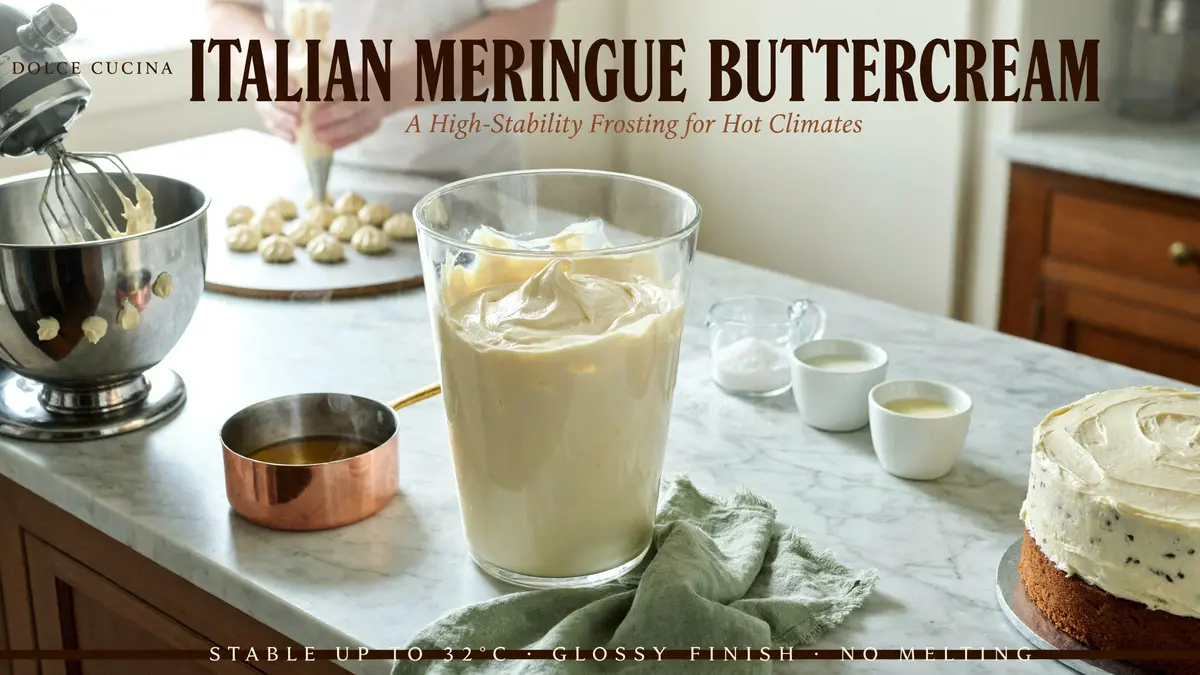
Italian meringue buttercream (IMBC) is the frosting professional bakers reach for when heat is a concern. It’s silky, glossy, barely sweet, and noticeably more stable than American or Swiss meringue buttercream. It’s also the most technical of the three, because it requires cooking sugar syrup to an exact temperature.
In this guide you’ll learn how Italian meringue buttercream works, why it holds up better in warm weather (and where its limits are), a cookie-sized recipe, step-by-step technique, flavor and stability variations, and fixes for the most common problems. This article is part of our pillar guide to Gourmet Frostings, Glazes, and Cream Cheese Icing, and it builds on our comparison of Swiss meringue vs. American buttercream.
💡 Quick take: Italian meringue buttercream is made by pouring sugar syrup cooked to 240–245°F (115–118°C) into whipping egg whites, cooling the meringue completely, then beating in soft butter. It holds a swirl better in warm weather than other buttercreams, but it’s still butter-based, so it isn’t heat-proof.
What Is Italian Meringue Buttercream?
All meringue buttercreams start with egg whites and sugar, then add butter. They differ in how the meringue is cooked:
- Swiss meringue buttercream: Egg whites and sugar are warmed together over simmering water to 160°F (71°C), then whipped.
- Italian meringue buttercream: A hot sugar syrup, cooked to the soft-ball stage (about 240°F / 115°C), is poured into whipping egg whites. The hot syrup cooks and sets the whites, creating a very stable foam.
The result is a frosting that’s lighter and fluffier than American buttercream, with a smooth, almost mousse-like texture. Because the sugar is dissolved in the meringue rather than sitting as powdered sugar in a base of butter, it’s also the least sweet of the three.
Why It Holds Up Better in Warm Weather
Three things make Italian meringue buttercream more resilient than the others:
- A very stable foam. Sugar cooked to 240°F has lost most of its water, so it’s highly concentrated. When it hits the egg whites, it sets the proteins firmly, creating a stronger structure than the gently heated Swiss version.
- Less reliance on butter for structure. The meringue carries more of the frosting’s body, so it’s less dependent on cold butter to hold its shape.
- No powdered sugar. Powdered sugar frostings turn sticky and slack in humid air; a cooked meringue base is less affected.
The honest limits: Italian meringue buttercream is still a large proportion of butter. In direct sun, a hot car, or a very warm room, it will soften and eventually melt. Think of it as “more forgiving,” not “heat-proof.” Keep frosted cookies out of direct sun, refrigerate them until serving, and pipe a little thicker than you think you need.
Comparison: Three Buttercreams
| American | Swiss meringue | Italian meringue | |
|---|---|---|---|
| Method | Beat butter and powdered sugar | Heat whites and sugar to 160°F, whip, add butter | Pour 240°F syrup into whites, whip, add butter |
| Sweetness | Very sweet | Moderate | Mild |
| Texture | Dense | Silky | Silky and light |
| Heat stability | Fair (crusts) | Fair | Best of the three |
| Difficulty | Easy | Intermediate | Advanced |
| Equipment | Mixer | Mixer, thermometer | Mixer, candy thermometer, saucepan |
| Eggs | No | Yes | Yes |
| Best for | Fast, bold swirls | Silky, less sweet finishes | Warm weather, make-ahead, professional piping |
Before You Begin: Key Rules
- A candy thermometer is not optional. The syrup temperature controls the result. Too low and the buttercream is soupy; too high and it can turn grainy.
- Use fresh egg whites. They whip better than carton whites. Make sure your bowl and whisk are completely clean and grease-free; a trace of fat or yolk will stop the whites from whipping.
- Have everything ready first. The syrup and the whites need to be ready at the same time. Weigh all ingredients, set up the mixer, and have the butter cut into pieces at cool room temperature.
- Work safely. Sugar syrup at 240°F can cause serious burns. Use a pan with a handle, pour slowly, and keep your hands and face clear of the mixer.
Recipe: Italian Meringue Buttercream for Cookies
This is a half-batch scaled for about 10 large cookies, using the same proportions as classic recipes (about 1 part egg whites to 1⅔ parts sugar to 3 parts butter by weight). It yields about 3 cups.
Prep time: 50 minutes
Ingredients
Meringue
- 3 large egg whites (about 90 g), fresh, at room temperature
- ¼ teaspoon fine salt
- 1 teaspoon cream of tartar (optional, helps stabilize)
Sugar syrup
- ¾ cup (150 g) granulated sugar
- ⅓ cup (80 ml) water
Finish
- 1¼ cups (283 g) unsalted butter, softened but cool (about 65–68°F / 18–20°C), cut into tablespoon-size pieces
- 1½ teaspoons vanilla extract
Equipment: stand mixer with whisk and paddle attachments, candy thermometer, small heavy saucepan
Instructions
- Prepare. Put the egg whites, salt, and cream of tartar in the clean bowl of your stand mixer. Cut the butter into pieces and set it out.
- Cook the syrup. Combine the sugar and water in a small, heavy saucepan. Stir over medium heat just until the sugar dissolves, then stop stirring. Clip on the thermometer and let the syrup boil until it reaches 240–245°F (115–118°C). Avoid going above about 250°F (120°C), where it starts to color and can leave the buttercream grainy.
- Time the whites. When the syrup reaches about 235°F (113°C), start whipping the egg whites on medium-high speed until they reach soft peaks: foamy and bright white, with a tip that curls over when you lift the whisk.
- Pour the syrup. As soon as the syrup reaches 240–245°F, remove it from the heat. With the mixer on medium-low, slowly pour the syrup in a thin, steady stream down the side of the bowl, not directly onto the whisk, which can splatter the syrup into hard strands.
- Whip until cool. Increase the speed to medium-high and whip for 8–12 minutes until the meringue is stiff, glossy, and the outside of the bowl feels cool or barely warm to the touch. Do not add butter while the meringue is still warm, or the frosting will be soupy.
- Add the butter. Switch to the paddle attachment, reduce the speed to medium-low, and add the butter one piece at a time, waiting until each is blended in before adding the next.
- Don’t panic. The mixture may look soupy, curdled, or separated partway through. Keep beating, and it will come together into a smooth, silky buttercream.
- Finish. Add the vanilla and beat on low for 1–2 minutes to push out air bubbles.
- Use. Pipe onto completely cooled cookies, or cover and store as described below.
Small-Batch Tip
Cooking a small amount of syrup can make it hard to get a reliable thermometer reading, because the liquid may not cover the probe. Use a small, narrow saucepan and tilt it if needed. Alternatively, make a full batch (double the recipe) and freeze half.
Variations
- Vanilla bean: Scrape the seeds of half a vanilla bean into the finished buttercream.
- Citrus: Beat in 1 tablespoon of finely grated lemon or orange zest at the end. Zest adds flavor without liquid, as we explain in our guide to flavor infusion.
- Chocolate: Melt 3 oz (85 g) of bittersweet chocolate, let it cool to lukewarm, and beat it in at the end. Some bakers also add cooled melted white or dark chocolate to firm the frosting for hot weather.
- Fruit: Fold in 2–3 tablespoons of sifted freeze-dried fruit powder after the butter.
- Espresso: Dissolve 1–2 teaspoons of instant espresso powder in the vanilla and beat in at the end.
- Browned butter: Replace some of the butter with chilled browned butter for a nutty note, as in our browned butter frosting guide. It will be a little softer.
Add flavorings at the very end, and keep liquids to a minimum.
Tips for Hot Weather
- Chill the cookies and the frosting before assembly. A cold cookie and cool frosting give you more time.
- Pipe in small batches. Keep the bowl or bag in the refrigerator between rounds.
- Pipe a slightly thicker swirl. It holds its shape better and takes longer to slump.
- Refrigerate frosted cookies until serving, then let them sit for 15–20 minutes so the frosting softens slightly.
- Keep out of the sun and away from ovens. Even brief exposure can soften the surface.
- Don’t leave dairy- and egg-based frostings out for more than about 2 hours.
Troubleshooting Italian Meringue Buttercream
| Problem | Likely cause | Fix |
|---|---|---|
| Buttercream is soupy | Meringue still warm when butter went in, or butter too soft | Chill the bowl 15–20 minutes, then re-whip on low |
| Looks curdled or split | Butter too cold, or mixture too cold | Warm the bowl briefly with a warm towel or hair dryer and beat on low |
| Buttercream is grainy | Syrup cooked too hot, or sugar crystals in the syrup | Re-make with a thermometer; avoid stirring once boiling |
| Hard sugar strands in the frosting | Syrup poured onto the whisk | Strain if needed; next time pour down the side of the bowl |
| Whites won’t whip | Grease or yolk in the bowl, or old whites | Start over with clean equipment and fresh whites |
| Meringue deflates | Syrup added too quickly | Pour in a slow, thin stream |
| Buttercream tastes eggy | Not whipped enough or poor-quality eggs | Whip longer; use fresh eggs; add a little more vanilla |
| Buttercream has air bubbles | Overwhipped after adding butter | Beat on lowest speed with the paddle for a few minutes |
| Frosting is too soft in warm room | Heat | Refrigerate and pipe in batches; see hot weather tips |
For more texture fixes, see our guide to grainy frostings.
Food Safety
The hot sugar syrup cooks the egg whites as it’s poured in, which is why Italian meringue is widely used in professional baking. If you’re serving people who are told to avoid raw or undercooked eggs, such as pregnant women, very young children, older adults, or people with weakened immune systems, check current food-safety guidance for your region or choose an egg-free frosting such as American buttercream.
Storing Italian Meringue Buttercream
- Refrigerator: Store in an airtight container with plastic wrap pressed onto the surface for about 3–5 days.
- Freezer: Freeze for up to about 3 months in an airtight container.
- To reuse: Thaw overnight in the refrigerator, bring it to cool room temperature, and re-whip on low until smooth. If it looks curdled, keep beating; it will usually come back.
- Frosted cookies: Store in the refrigerator in a single layer in an airtight container, and eat within a few days.
For detailed storage guidance, see our guide to storing and freezing frostings.
Which Cookies Suit Italian Meringue Buttercream?
- Sturdy, thick cookies: Sugar cookies, shortbread, and brown butter cookies carry the frosting well.
- Fruit and citrus cookies: The mild sweetness lets flavors like our lemon cookies come through.
- Summer cookies: Strawberry, key lime, and s’mores cookies served at outdoor gatherings.
- Less ideal: Very soft or fragile cookies, which can’t support a tall swirl.
Expert Resources on Italian Meringue Buttercream
- Sugar Geek Show — Italian Meringue Buttercream — A detailed explanation of the syrup temperature, meringue stage, and why this version is the most stable.
- King Arthur Baking — Italian Buttercream Frosting — Notes on syrup temperature ranges and how the syrup cooks the meringue.
- Wilton — How to Make Italian Meringue Buttercream — A step-by-step guide with standard proportions.
- Veena Azmanov — Italian Meringue Buttercream — A pastry decorator’s tips on stability and shelf life, including use in hot, humid conditions.
Frequently Asked Questions
What temperature should the sugar syrup be for Italian meringue buttercream?
About 240–245°F (115–118°C), the soft-ball stage. Below that, the buttercream may be soupy; above about 250°F, the syrup can start to caramelize and the buttercream can turn grainy.
Is Italian meringue buttercream better than Swiss meringue buttercream?
It’s more stable in warm weather and a little lighter, but it’s also harder to make because it requires a candy thermometer and careful timing. Swiss meringue is simpler and still silky.
Is Italian meringue buttercream heat-proof?
No. It holds up better than other buttercreams, but it’s still mostly butter and will soften and melt in strong heat. Keep it cool and out of direct sun.
Why is my Italian buttercream soupy?
Usually the meringue was still warm when the butter went in. Chill the bowl for 15–20 minutes and re-whip. The butter can also be too soft.
Do I need a candy thermometer?
It’s strongly recommended. Some bakers use the cold-water soft-ball test, but a thermometer is more reliable.
Can I make Italian meringue buttercream ahead of time?
Yes. Refrigerate it for 3–5 days or freeze up to about 3 months, then thaw slowly and re-whip.
Is Italian meringue buttercream safe to eat?
The hot syrup cooks the egg whites, and it’s widely used in professional baking. If you serve people who need to avoid undercooked eggs, check food-safety guidance or choose an egg-free frosting.
Can I flavor Italian meringue buttercream?
Yes. Add extracts, zests, cooled melted chocolate, or fruit powders at the end, and keep liquids minimal.
About the Author
Chef Emily Chen is a Recipe Developer at Cookie Insights. With over a decade of hands-on pastry experience and a passion for cookie science, she tests and shares foolproof techniques for glazes, doughs, and frostings. Connect with Elena through the Cookie Insights community or via email with your baking questions.
Continue Exploring Gourmet Frostings
Head back to the Gourmet Frostings, Glazes, and Cream Cheese Icing pillar guide, compare options in our Swiss meringue vs. American buttercream guide, or learn how to keep other frostings firm with our guide to stabilizing cream cheese icing.
Leave a Reply