
Author note Written by: Sarah Jenkins, Senior Recipe Developer at Cookie Insights Background: Trained at the French Culinary Institute with over eight years of professional recipe testing experience, focusing on precision baking and gourmet cookie variations.
Last updated: October 26, 2026
Recipe testing: Tested across five iterative batches to ensure the butter-to-meringue ratio holds a stable piping consistency without splitting.
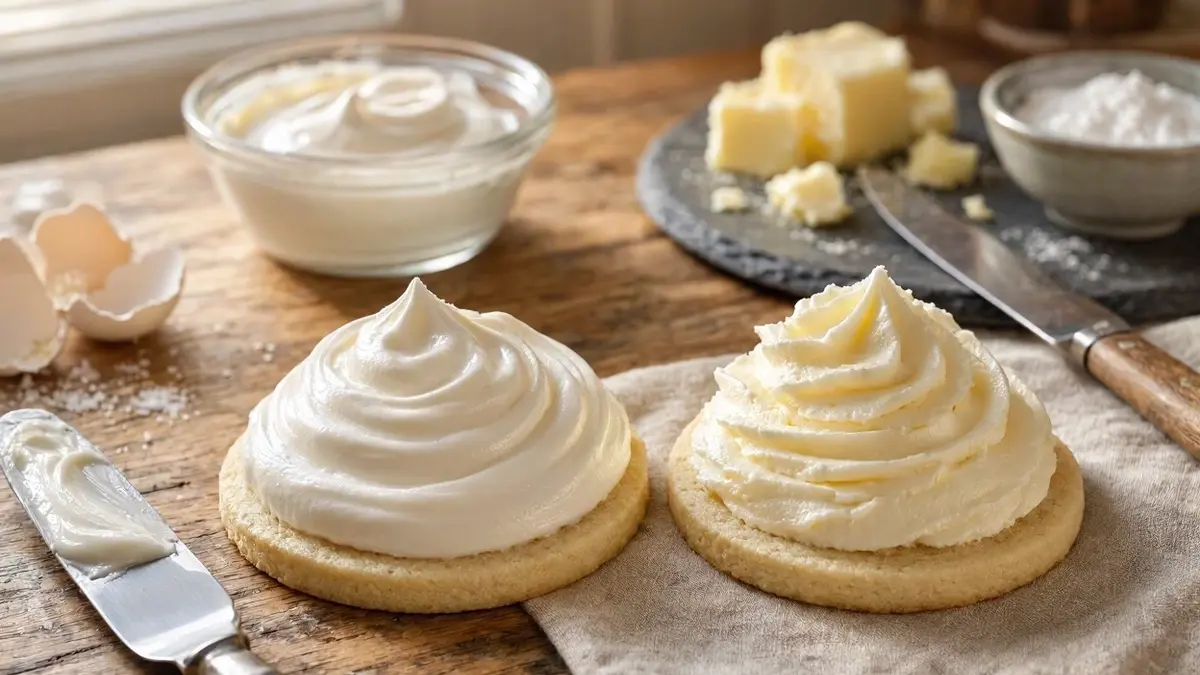
There are two buttercreams you’ll see on most gourmet cookies. One is made in five minutes with butter and powdered sugar. The other involves a thermometer, a pot of simmering water, and a good 30 minutes. Both are called buttercream, both pipe a beautiful swirl, and they taste and behave very differently.
This guide compares American buttercream and Swiss meringue buttercream (SMBC) specifically for cookies: how each tastes and feels, how they hold up on a cookie, when each is the better choice, and how to make a cookie-sized batch of Swiss meringue buttercream. This article is part of our pillar guide to Gourmet Frostings, Glazes, and Cream Cheese Icing, where American buttercream is one of the four frosting families.
💡 Quick take: Choose American buttercream when you want something fast, sturdy, and very sweet that holds a tall, thick swirl and crusts slightly on top. Choose Swiss meringue buttercream when you want a silky, buttery, much less sweet frosting that stays soft and doesn’t crust — and you don’t mind the extra steps.
What Is American Buttercream?
American buttercream is the simplest buttercream: butter beaten until light, then combined with sifted powdered sugar, a little liquid, vanilla, and salt. Nothing is cooked, and there are no eggs.
As our pillar guide explains, it’s sweeter and denser than meringue-based buttercreams, which makes it ideal for the thick, swirled applications common on Crumbl-style cookies. Because it’s mostly butter and sugar, it forms a light crust as it sits, which helps frosted cookies stack or travel more easily.
For technique tips, see our guides to sifting powdered sugar and browned butter frosting.
What Is Swiss Meringue Buttercream?
Swiss meringue buttercream starts with a meringue. Egg whites and granulated sugar are whisked together over a pot of simmering water until they reach 160°F (71°C), which dissolves the sugar and heats the egg whites enough to be safe to eat. The mixture is then whipped to a stiff, glossy meringue, cooled, and beaten with soft butter a little at a time until it turns smooth and silky.
The result is a frosting that’s lighter in color, much less sweet, and noticeably more buttery than American buttercream. It doesn’t form a crust, and it keeps a soft, creamy texture.
Side-by-Side Comparison
| American buttercream | Swiss meringue buttercream | |
|---|---|---|
| Main ingredients | Butter, powdered sugar, cream or milk, vanilla | Egg whites, granulated sugar, butter, vanilla |
| Sweetness | Very sweet | Moderately sweet, more buttery |
| Texture | Dense, thick, slightly grainy if rushed | Silky, light, smooth |
| Crusts as it sits? | Yes, develops a light crust | No |
| Contains eggs? | No | Yes (egg whites cooked to 160°F / 71°C) |
| Time | About 10 minutes | About 30–40 minutes |
| Equipment | Mixer | Mixer, thermometer, heatproof bowl, saucepan |
| Skill level | Beginner | Intermediate |
| Piping | Thick, bold swirls | Smooth, defined swirls |
| Color | Ivory to yellow (from butter) | Paler ivory |
| Cost | Lower | Higher (more butter) |
| Best for | Fast bakes, bold sweet swirls, travel | Less sweet cookies, refined finishes |
How They Perform on Cookies
Sweetness
Cookies are already sweet, so the frosting sets the balance. American buttercream on a sugar cookie is a very sweet pairing; SMBC lets the cookie’s flavor come through. If your cookie is rich or chocolatey, SMBC often tastes more balanced.
Texture and mouthfeel
American buttercream is dense and slightly sandy; many people love that nostalgic, bakery-case texture. SMBC is silky and melts on the tongue. On a thick, soft cookie, either works, but SMBC feels lighter.
Handling and piping
Both pipe well with a large star tip such as 1M or 2D. American buttercream gives bolder, thicker shapes. SMBC gives smoother edges and more refined definition, but it’s softer, so piped swirls may be slightly less tall.
Stability and heat
Both are butter-based, so neither is heat-proof. Swiss meringue buttercream can sit covered at room temperature for a day or two (Sally’s Baking Addiction suggests 1–2 days, then refrigeration), while American buttercream’s crust helps it hold up in transit. In a hot kitchen or at an outdoor party, keep both in the shade or the refrigerator. For truly hot climates, see our guide to Italian meringue buttercream in this cluster.
Crusting
American buttercream crusts lightly; SMBC doesn’t. For stacking frosted cookies in a box, a crust is an advantage. For soft, melt-in-the-mouth cookies, no crust is a plus.
Food safety
American buttercream has no eggs. SMBC does, though heating the whites to 160°F (71°C) makes them safe to eat. If you serve people who need to avoid eggs entirely, or you can’t use a thermometer, choose American buttercream.
Recipe 1: American Buttercream for Cookies
This is the base recipe for a thick, swirlable frosting. It yields about 2 cups, enough for 10 large cookies.
Ingredients
- 1 cup (227 g) unsalted butter, softened but cool
- 3 cups (360 g) powdered sugar, sifted
- 1–2 tablespoons heavy cream or milk
- 1 teaspoon vanilla extract
- ¼ teaspoon fine salt
Instructions
- Beat the butter on medium for 2 minutes until pale and creamy.
- Add the sifted powdered sugar a cup at a time on low, then add the vanilla and salt.
- Add 1 tablespoon of cream and beat on medium-high for 3–4 minutes, until light and fluffy. Add the second tablespoon only if needed.
- Pipe or spread on completely cooled cookies.
Recipe 2: Swiss Meringue Buttercream for Cookies
This half-batch recipe uses the same ratio as a classic SMBC and yields about 2½ cups, enough for 10 large cookies. Weigh the ingredients and use a thermometer.
Prep time: 40 minutes
Ingredients
- 3 large egg whites (about 90 g), fresh, at room temperature
- ¾ cup (150 g) granulated sugar
- 1 cup (227 g) unsalted butter, softened but cool (about 65–68°F / 18–20°C), cut into tablespoon-size pieces
- 1½ teaspoons vanilla extract
- ¼ teaspoon fine salt
Instructions
- Prepare the double boiler. Fill a saucepan with about 2 inches (5 cm) of water and bring to a gentle simmer. The bottom of your mixing bowl must not touch the water.
- Heat the whites and sugar. In the heatproof bowl of your stand mixer, whisk the egg whites and sugar together. Set the bowl over the simmering water and whisk constantly until the mixture reaches 160°F (71°C) and the sugar has fully dissolved (rub a drop between your fingers: it should feel smooth, not gritty). This takes about 3–4 minutes.
- Whip to stiff peaks. Transfer the bowl to the mixer fitted with the whisk attachment. Whip on medium-high for 8–10 minutes, until the meringue is thick, glossy, and the bowl feels completely cool to the touch. This step is critical: warm meringue will melt the butter.
- Switch to the paddle. Swap to the paddle attachment and beat on medium-low.
- Add the butter. Add the butter one piece at a time, waiting until each is incorporated before adding the next. The mixture may look soupy or curdled partway through; keep beating and it will come together.
- Finish. Add the vanilla and salt and beat on low for 2–3 minutes to push out air bubbles and make it silky.
- Pipe. Use immediately on cooled cookies, or cover and keep as directed below.
Tips for Success
- Use fresh egg whites. Fresh whites whip better than carton whites, and a trace of yolk or grease can stop them from whipping at all. Wipe the bowl and whisk with a little white vinegar or lemon juice first.
- Check the temperature. Heat to 160°F (71°C) for safety and sugar dissolving. Don’t overheat or the whites will scramble.
- Cool the meringue completely. If the bowl still feels warm, wait. Most failed batches are a temperature problem.
- Keep the butter soft but cool. Butter that’s too warm makes soupy frosting; too cold makes lumpy frosting.
Troubleshooting
| Problem | Likely cause | Fix |
|---|---|---|
| SMBC is soupy or runny | Meringue or butter too warm | Chill the bowl 10–15 minutes, then re-whip |
| SMBC looks curdled or split | Butter too cold, or mixture too cool | Warm the bowl briefly with a warm towel or hair-dryer, then beat on medium |
| SMBC won’t whip to peaks | Egg yolk or grease in the whites, or whites not fully heated | Start over with clean equipment and fresh whites |
| SMBC has air bubbles | Overwhipped after the butter went in | Beat on the lowest speed with the paddle for a few minutes |
| SMBC tastes eggy | Whites not fully dissolved or too much beating | Use fresh eggs and a bit more vanilla; add a pinch of salt |
| American buttercream is grainy | Sugar unsifted or butter too cold | Sift; soften butter slightly; beat 3–4 minutes |
| American buttercream is too sweet | Standard recipe | Add a pinch of salt, use browned butter, or switch to SMBC |
| Buttercream melts on the cookie | Cookies still warm | Frost only completely cooled cookies |
Storing Each Frosting
- American buttercream: Refrigerate in an airtight container for up to a week or freeze up to 2 months. Bring to cool room temperature and re-whip before using.
- Swiss meringue buttercream: Keep covered at room temperature for 1–2 days, refrigerate for up to 5 days, or freeze for up to 3 months. If it looks broken after chilling, let it come to room temperature and re-whip on low until smooth.
- Frosted cookies: Store in a single layer in an airtight container. American buttercream’s crust helps with stacking; SMBC-frosted cookies need more careful handling.
Which Should You Choose?
| If you… | Choose |
|---|---|
| Need frosting in 10 minutes | American buttercream |
| Want a bold, tall, Crumbl-style swirl | American buttercream |
| Are baking for kids who love very sweet frosting | American buttercream |
| Need frosted cookies to stack or travel | American buttercream |
| Dislike very sweet frosting | Swiss meringue buttercream |
| Want a silky, bakery-style finish | Swiss meringue buttercream |
| Are frosting rich, chocolate, or caramel cookies | Swiss meringue buttercream |
| Can’t use eggs | American buttercream |
| Have a thermometer and 40 minutes | Either |
Cookie Pairing Ideas
- American buttercream: Sugar cookies, chocolate chip, funfetti, and anything meant to taste like birthday cake. See our sugar cookie recipe for decorating.
- Swiss meringue buttercream: Brown butter cookies, double chocolate, lemon, and espresso cookies. Try it on our lemon cookies, where its lightness lets citrus come through.
Expert Resources on Swiss Meringue and American Buttercream
- Sally’s Baking Addiction — Swiss Meringue Buttercream — A detailed recipe with troubleshooting and make-ahead and freezing instructions.
- Brown Eyed Baker — Swiss Meringue Buttercream — Explains how SMBC differs from Italian and American buttercream, including the 160°F step.
- Beyond Frosting — Swiss Meringue Buttercream — Covers flavor options, gel coloring, and freezing.
- Natasha’s Kitchen — Swiss Meringue Buttercream — A step-by-step recipe with a “why is it soupy?” section.
Frequently Asked Questions
Is Swiss meringue buttercream less sweet than American buttercream?
Yes. Because it uses cooked granulated sugar in a meringue rather than large amounts of powdered sugar, it tastes buttery and smooth rather than intensely sweet.
Is Swiss meringue buttercream safe to eat with raw eggs?
The egg whites aren’t raw. They’re heated to 160°F (71°C) over simmering water before whipping, which is the standard temperature used in recipes to make them safe. Use a thermometer to be sure.
Which buttercream is better for piping on cookies?
Both work. American buttercream is easier for bold, tall swirls; Swiss meringue buttercream gives smoother, more refined definition but is slightly softer.
Can I use Swiss meringue buttercream on warm cookies?
No. Like all butter-based frostings, it melts on warm surfaces. Frost only completely cooled cookies.
Why did my Swiss meringue buttercream curdle?
Usually a temperature problem: the butter was too cold, or the meringue was too cool. Warm the bowl gently, or chill it if it’s too warm, and keep beating. It almost always comes back together.
Can I flavor Swiss meringue buttercream?
Yes. Add extracts, melted and cooled chocolate, fruit powders, or citrus zest at the end. Liquid flavors should be added sparingly or they can loosen the frosting.
Which is better for hot weather?
Neither is heat-proof because both are mostly butter. Keep frosted cookies out of direct sun and refrigerate them until serving. Italian meringue buttercream is more stable for warm climates.
About the Author
Emily Chen is a recipe developer and baking enthusiast who loves exploring the precise chemistry behind the perfect cookie and silky-smooth frosting. With a passion for testing ingredient ratios, temperatures, and techniques, Emily Chen breaks down the science of baking so home cooks can achieve bakery-quality results every single time.
Continue Exploring Gourmet Frostings
Head back to the Gourmet Frostings, Glazes, and Cream Cheese Icing pillar guide for all four frosting families, learn how to firm up cream cheese icing in our stabilizing guide, or smooth every frosting with our guide to sifting powdered sugar.
Leave a Reply