
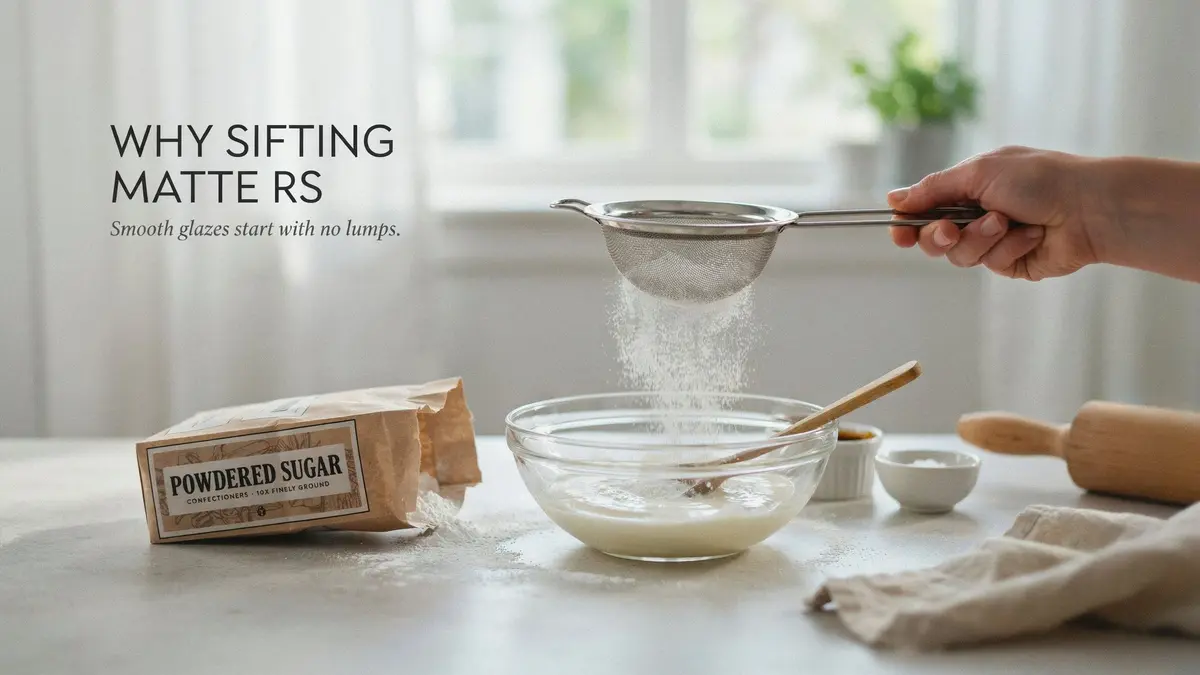
A quick note from the kitchen:
If you’ve ever mixed up a fresh batch of glaze only to find stubborn white lumps floating on top, or watched your favorite cookies turn grainy, you aren’t alone. Powdered sugar might look simple, but it loves to clump. After testing dozens of glaze ratios and testing out why frostings fail, I’ve found that one simple step—sifting—completely changes the texture. Let’s dive into the exact science and ratios you need for a flawlessly smooth finish every single time.
Powdered sugar looks like the simplest ingredient in your pantry. It’s sugar, only finer. But it’s also the ingredient behind most frosting failures: the lumps in a glaze that never dissolve, the grainy buttercream that feels like sand, the icing that’s somehow too thick and too thin at the same time.
Most of those problems come down to one small step many bakers skip: sifting. In this guide you’ll learn what powdered sugar actually is, what sifting does and what it doesn’t, how to sift quickly and cleanly, how to measure it accurately, glaze ratios for every consistency, and how to make your own powdered sugar in a pinch. This article is part of our pillar guide to Gourmet Frostings, Glazes, and Cream Cheese Icing, where sifting is the first rule for smooth results.
💡 Quick take: Sifting removes lumps and aerates the sugar so it dissolves and blends evenly. It won’t make coarse sugar finer, and it won’t fix cold butter or undissolved granulated sugar — but for glazes, royal icing, and buttercream, it’s the cheapest insurance against lumps you can buy.
What Is Powdered Sugar?
Powdered sugar (also called confectioners’ sugar, icing sugar, or 10X sugar) is granulated sugar ground to a fine powder, usually with a small amount of cornstarch added to keep it from caking. In the U.S., the cornstarch content is commonly about 3%.
Two details explain most of what you’ll see in the kitchen:
- It clumps easily. Powdered sugar absorbs moisture from the air, and even a small amount of humidity or pressure in the bag creates hard lumps. The cornstarch slows this down but doesn’t eliminate it.
- It dissolves fast, but only if it’s distributed. Because the particles are so small, powdered sugar dissolves quickly in liquids and butter, but a clump will stay as a lump unless you break it up.
You may also see “10X” on the package. The X designation describes how finely the sugar is ground; the higher the number, the finer the powder. Supermarket powdered sugar is usually 10X.
What Sifting Actually Does (and Doesn’t)
Sifting does:
- Remove lumps. Clumps that formed in the bag stay behind in the sieve instead of ending up in your glaze.
- Aerate the sugar. Sifted sugar is lighter and fluffier, so it blends more evenly into butter or liquid.
- Make measurements more consistent. Powdered sugar packs down in the bag, so a cup scooped straight from it weighs more than a cup of sifted sugar. (See the measuring section below.)
- Create a smoother texture in glazes. Whisking lump-free sugar into liquid gives a seamless finish with no pits or speckles.
Sifting doesn’t:
- Make the sugar finer. If the powdered sugar is coarse, sifting won’t change its particle size.
- Fix cold butter. A grainy buttercream is often caused by butter that’s too cold to absorb the sugar, not by the sugar itself.
- Replace beating. Frosting still needs 2–4 minutes of mixing to dissolve the sugar into the fat.
- Eliminate the sweetness. If your frosting tastes too sweet, balance it with salt, vanilla, or a tangy ingredient rather than reducing the sifting.
When Sifting Matters Most
Not every recipe needs the same effort. As a rule:
- Always sift for glazes, royal icing, mirror glaze toppings, and anything poured, dipped, or piped in fine detail. Lumps show up immediately.
- Usually sift for buttercream and cream cheese frosting, particularly when you’re adding several cups.
- Sift if it’s old or lumpy for dusting cookies or adding a little to dough.
- You can skip it when the sugar is clearly free-flowing and you’re adding a small amount to a large, forgiving mixture (such as a cookie dough).
Because lumps form during storage, check the sugar by pressing it between your fingers: if you feel hard bits, sift. If it’s soft and powdery throughout, you can often get away with a quick whisk.
How to Sift Powdered Sugar Without the Mess
- Use a fine-mesh sieve. A mesh sieve is faster and cleaner than a flour sifter with a squeeze handle.
- Sift into a bowl or onto parchment. Parchment paper makes it easy to lift the corners and pour the sugar into your mixer without spilling.
- Tap, don’t shake. Hold the sieve over the bowl and tap the side with your hand. Shaking sends sugar dust everywhere.
- Break up stubborn lumps. Press them through the mesh with the back of a spoon or a silicone spatula. Discard anything that won’t go through.
- Sift in batches. For several cups, sift a cup or two at a time so the sieve doesn’t clog.
- Rescue very lumpy sugar. If the whole bag has hardened, pulse it in a food processor or blender for 20–30 seconds, let the dust settle, and sift again.
Measuring Powdered Sugar Accurately
Sifted sugar is lighter than packed sugar, so a cup measured one way isn’t the same as a cup measured the other. Two phrases in recipes mean different things:
- “1 cup sifted powdered sugar” means sift first, then measure.
- “1 cup powdered sugar, sifted” means measure first, then sift.
The easiest way to avoid the confusion is to weigh it. As a working rule, 1 cup of powdered sugar is about 120 g (4¼ oz). All of our recipes list grams for this reason. If you use cups, spoon the sugar lightly into the measuring cup and level it off without packing it down.
Glaze Ratios: Getting the Consistency Right
Powdered sugar glaze has only two components — sugar and liquid — so small changes show up immediately. These ratios are starting points; the liquid you use (milk, cream, lemon juice, water) and your kitchen’s humidity will shift the result, so always add liquid gradually.
| Consistency | Powdered sugar | Liquid | Best for |
|---|---|---|---|
| Thick (spreads, holds shape) | 1 cup (120 g) | 1 tablespoon (15 g) | Spreading on cooled cookies, thick drizzle, sandwich cookies |
| Medium (dips, sets with a soft shell) | 1 cup (120 g) | 2 tablespoons (30 g) | Dipping cookie tops, classic glazed cookies |
| Thin (runs, sets glossy and translucent) | 1 cup (120 g) | 3 tablespoons (45 g) | Light drizzles, brushing on warm cookies |
Basic Vanilla Glaze
Yield: enough to glaze about 8–10 cookies
- 1 cup (120 g) powdered sugar, sifted
- 2 tablespoons (30 g) milk or cream, plus more as needed
- ½ teaspoon vanilla extract
- Pinch of fine salt
- Sift the powdered sugar into a bowl.
- Whisk in the milk, vanilla, and salt until completely smooth, starting with a little less liquid than you think you need.
- Adjust. Add milk a teaspoon at a time to thin, or sifted powdered sugar a tablespoon at a time to thicken.
- Use right away. Dip or spread on fully cooled cookies and let set at room temperature for 30–60 minutes. Glazes crust as they dry, so keep the bowl covered with a damp towel while you work.
Tip: Add a teaspoon of light corn syrup for a smoother, glossier finish that is less likely to crack when set.
DIY Powdered Sugar (in a Pinch)
If you’ve run out, you can make a substitute from granulated sugar:
- 1 cup (200 g) granulated sugar
- 1 tablespoon (8 g) cornstarch
Blend on high in a high-powered blender or food processor for 1–2 minutes until it’s a fine, fluffy powder. Let the dust settle for a minute before opening the lid, then sift. Homemade powdered sugar is usually a little coarser than store-bought 10X, so it works best for rustic glazes and dusting; for royal icing and mirror glaze, use store-bought.
Troubleshooting Powdered Sugar Problems
| Problem | Likely cause | Fix |
|---|---|---|
| Glaze has little white lumps | Sugar wasn’t sifted | Strain the glaze through a fine sieve, or whisk vigorously and let rest 5 minutes |
| Buttercream feels gritty | Butter too cold, or sugar not fully beaten in | Let butter soften slightly; beat 3–4 minutes; sift sugar next time |
| Glaze is too thin | Too much liquid | Whisk in sifted powdered sugar 1 tablespoon at a time |
| Glaze is too thick | Too little liquid | Add liquid 1 teaspoon at a time |
| Glaze stays sticky and won’t set | Humidity, or too much liquid | Let dry longer in a cool, dry room; use a little less liquid next time |
| Glaze is cracked or cloudy | Over-thick glaze or sugar not fully dissolved | Add a teaspoon of corn syrup; whisk until perfectly smooth |
| Frosting tastes starchy | Cornstarch in the sugar | Add a pinch of salt and a little vanilla; avoid adding extra cornstarch |
| Sugar is solid in the bag | Absorbed moisture | Break up, pulse in a food processor, and sift before using |
Storing Powdered Sugar
- Keep it airtight. Transfer opened bags to a sealed container or zip-top bag to keep moisture out.
- Store it dry. Choose a cool pantry away from the stove and sink.
- Fluff before using. Even properly stored sugar settles, so stir and sift it before measuring.
- Dust at the last minute. Powdered sugar dusted on cookies absorbs moisture and fades into the surface, so dust right before serving.
Dietary Notes
- Gluten-free: Powdered sugar usually contains cornstarch rather than wheat, but formulations vary, so check the label if you need certified gluten-free.
- Vegan: Some cane sugar is processed with bone char. If that matters to you, look for powdered sugar labeled vegan.
- Cornstarch-free: A small number of brands use other anti-caking agents or none at all. These tend to clump more, so sift every time.
Expert Resources on Powdered Sugar
- Food Network — What Is Confectioners’ Sugar? — A short guide to the names for powdered sugar, what it contains, how to use it, and how to make a substitute.
Frequently Asked Questions
Do I really need to sift powdered sugar?
For glazes, royal icing, and fine piping, yes: lumps are very visible. For buttercream, it’s strongly recommended. For a small amount dusted over cookies or added to dough, you can often skip it if the sugar is soft and free of lumps.
Why is my glaze lumpy even after whisking?
Lumps in powdered sugar are dry clumps coated with moisture on the outside. Whisking often can’t break them up once they’re wet. Sift before you add liquid, or strain the finished glaze through a fine sieve.
What’s the difference between powdered sugar, icing sugar, and confectioners’ sugar?
In most cases they’re the same product with different regional names. Formulations can vary slightly, such as the amount and type of anti-caking agent, so check the package if a recipe is precise.
How much does a cup of powdered sugar weigh?
About 120 g, depending on how it’s packed. Weighing is more reliable than cups and avoids the “sifted before or after measuring” problem.
Can I make powdered sugar from granulated sugar?
Yes. Blend 1 cup of granulated sugar with about 1 tablespoon of cornstarch until fine, let the dust settle, and sift. It works for most glazes and dusting but may be slightly grainier than store-bought.
Why does my powdered sugar taste starchy?
The small amount of cornstarch can be noticeable in frostings that use a lot of sugar and no cooking. Balance with salt and vanilla, and consider adding a tangy or toasted ingredient like cream cheese or browned butter.
How do I fix glaze that is too thin?
Whisk in sifted powdered sugar a tablespoon at a time until it thickens, and avoid adding more liquid.
About the Author
Emily Chen is a recipe developer and baking enthusiast who loves exploring the precise chemistry behind the perfect cookie and silky-smooth frosting. With a passion for testing ingredient ratios, temperatures, and techniques, Emily Chen breaks down the science of baking so home cooks can achieve bakery-quality results every single time.
Continue Exploring Gourmet Frostings
Now that your powdered sugar is smooth, explore the rest of the frosting basics in our Gourmet Frostings, Glazes, and Cream Cheese Icing pillar guide. Put your sifted sugar to work in our browned butter frosting guide, our guide to stabilizing cream cheese icing, or the mirror glaze guide.
Leave a Reply