
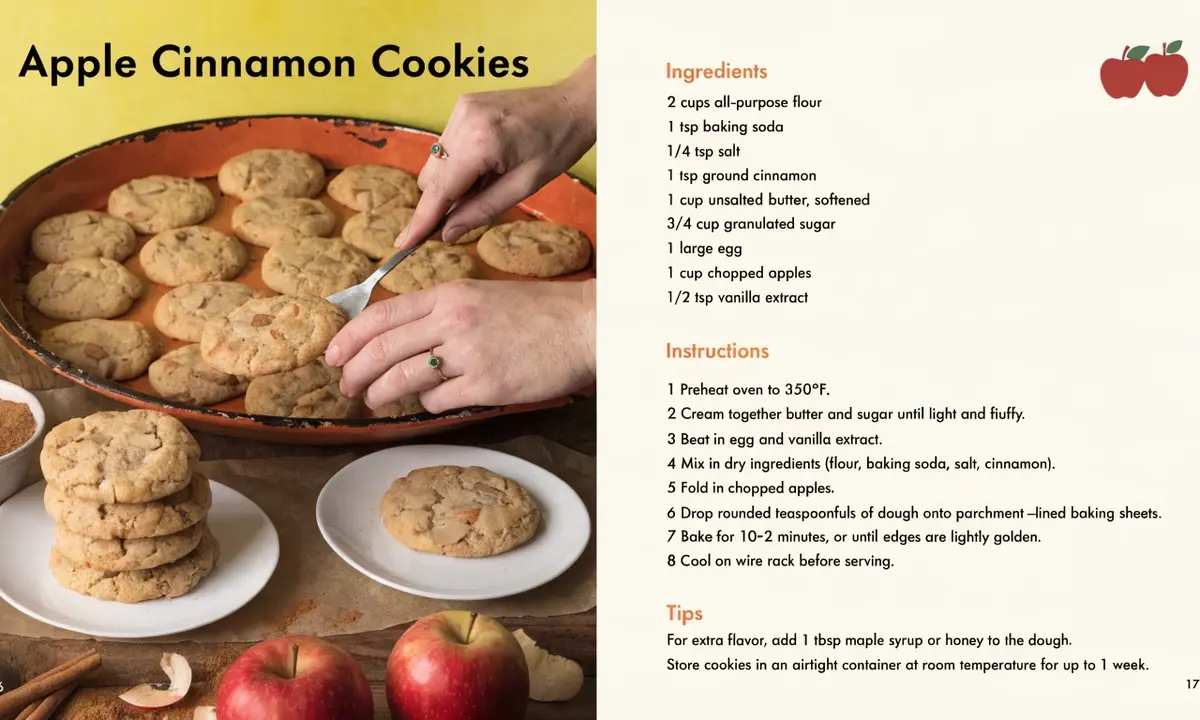
Apple and cinnamon is fall reduced to its two most essential flavors. The combination works because it is built on contrast — the bright acidity of apple against the warm, enveloping depth of cinnamon — and because both flavors are at their peak in September and October when orchard apples are harvested and the smell of cinnamon starts appearing in every coffee shop and kitchen. Together they capture autumn more completely than almost any other pairing in seasonal baking.
The challenge with apple in cookies is the same one that affects pumpkin: moisture. Fresh apple releases significant liquid during baking, which can turn a carefully constructed thick cookie into a soggy, dense, underbaked result. This recipe solves that problem with apple butter — a concentrated apple preserve that has been cooked down to remove excess moisture — rather than fresh or dried apple. Apple butter delivers intense, rounded apple flavor without any liquid risk, and its natural pectin content actually helps the dough hold together.
The result is a thick, chewy brown butter cookie with deep apple-cinnamon flavor, topped with a cinnamon cream cheese frosting that echoes the classic pairing without overwhelming the apple base. This article is part of the seasonal cookie flavors guide. For the full fall cookie lineup, see our pumpkin spice cookies and the upcoming caramel apple cookie recipe.
Why apple butter, not fresh apple
Fresh apple: releases 80%+ of its weight as steam during baking, creating soggy pockets and unpredictable moisture. Dried apple: chewy texture contrast that can work, but inconsistent hydration during baking. Apple butter: moisture already cooked out, flavor concentrated 8–10x versus fresh apple, natural pectin adds body to the dough, consistent results every time. One jar of store-bought apple butter is all you need.
Choosing the Right Apple Butter
Not all apple butters are created equal for baking. The variables that matter:
- Sugar content: Some apple butters are heavily sweetened; others rely almost entirely on the natural sugars from slow-cooked apples. For baking, lower-sugar or unsweetened apple butter gives you more control over the final sweetness of the cookie. If yours is sweetened, reduce the brown sugar in the recipe by 25g.
- Spice level: Many commercial apple butters include cinnamon, nutmeg, and cloves. If yours is pre-spiced, reduce the added cinnamon in this recipe by ½ teaspoon and taste the dough before adding more. Double-spiced cookies can tip from complex into harsh.
- Consistency: Apple butter should be thick and smooth — similar to a very thick jam. If yours is thinner or more liquid, cook it down in a small saucepan over medium heat until it reduces by about 20% before using. Thinner apple butter reintroduces the moisture problem you’re trying to avoid.
- Brand notes: Musselman’s, Smucker’s, and Trader Joe’s all make consistently good apple butters for baking. Farmer’s market and local orchard apple butter often has more complex flavor but variable consistency — worth using when available.
The Recipe
Ingredients — Makes 12–14 large cookies
Cookie dough
- 170g (¾ cup / 1½ sticks) unsalted butter, browned and cooled
- 180g (¾ cup) dark brown sugar, packed
- 50g (¼ cup) granulated sugar
- 130g (½ cup) apple butter — thick, good quality
- 1 large egg, room temperature
- 1 tsp pure vanilla extract
- 300g (2½ cups) all-purpose flour
- 1 tsp baking soda
- ½ tsp baking powder
- ¾ tsp fine sea salt
- 2½ tsp ground cinnamon
- ½ tsp ground nutmeg
- ¼ tsp ground ginger
- ¼ tsp ground allspice
- Optional: 80g (½ cup) finely diced dried apple rings
Cinnamon cream cheese frosting
- 225g (8 oz) full-fat block cream cheese, cool room temp
- 115g (½ cup / 1 stick) unsalted butter, cool room temp
- 360g (3 cups) powdered sugar, sifted
- 1 tsp pure vanilla extract
- 1½ tsp ground cinnamon
- Pinch fine sea salt
Optional garnish
- Cinnamon sugar (2 tbsp sugar + 1 tsp cinnamon)
- Thinly sliced dried apple chip (decorative)
- Flaky sea salt
- Caramel drizzle (optional — bridges to the caramel apple flavor)
Method
1-Brown the butter
Melt butter in a light-colored saucepan over medium heat, stirring frequently. Cook 4–6 minutes until milk solids turn golden and the aroma is nutty and caramel-like. Pour into a large mixing bowl and cool to room temperature, about 30 minutes. Brown butter and apple butter together create a particularly rich, complex fall flavor — the nutty Maillard compounds from browning deepen and amplify the concentrated apple notes.
2-Combine wet ingredients
Whisk cooled brown butter with both sugars until combined. Add the apple butter and whisk until smooth and fully incorporated — the mixture will look thick and a warm tawny-brown color. Add the egg and vanilla extract and whisk vigorously for 1 minute until slightly lightened. The apple butter contains natural pectin that begins binding the mixture together at this stage, giving the dough more cohesion than a standard butter-sugar-egg mixture.
3-Add dry ingredients
Whisk flour, baking soda, baking powder, salt, and all spices together in a separate bowl. Add to the wet mixture all at once and fold with a rubber spatula until just combined — no dry streaks remain. If using dried apple pieces, fold them in at the end. The dough will be noticeably softer and stickier than a standard drop cookie dough due to the apple butter — this is correct. It firms up considerably during chilling.
4-Chill — minimum 2 hours, overnight preferred
Cover tightly and refrigerate for at least 2 hours. Apple butter keeps the dough soft and sticky even when well-mixed — it absolutely requires a thorough chill before scooping. Overnight chilling is strongly recommended: the apple and cinnamon flavors deepen and meld considerably, and the brown butter and apple butter develop into something more complex than the sum of their parts. The dough will firm to a scoopable consistency after a full overnight rest.
5-Scoop, press, and bake
Preheat oven to 375°F / 190°C — verify with an oven thermometer. Line baking sheets with parchment. Using a #16 disher scoop, portion dough into balls (approximately 60g each). Place 6 per half-sheet pan. Press each ball into a disc about 2cm thick with the flat bottom of a glass. Refrigerate the pan with shaped cookies for 10 minutes before baking — the apple butter softens quickly at room temperature during scooping. Bake 11–13 minutes until edges look set and the surface is matte. The center should still look slightly underdone. Pan-rest 10 full minutes before moving.
6-Make frosting and finish
Beat cream cheese and butter together on medium speed until smooth, about 2 minutes. Add sifted powdered sugar in two additions, beating on low between each. Add vanilla, cinnamon, and salt and beat on medium until smooth. Refrigerate 15 minutes if too soft. Apply with a 1M star tip or offset spatula on fully cooled cookies. Dust with cinnamon sugar immediately after frosting for a warm visual finish. Add a caramel drizzle if desired — it bridges cleanly to the caramel apple flavor profile of article 8.
The Apple Flavor Problem: Why Fresh Doesn’t Work and What Does
Apple is one of the most difficult fruits to use in cookie baking because its flavor compounds are highly volatile — they evaporate at relatively low temperatures, which means much of what makes an apple taste like an apple disappears during the baking process. Fresh apple in a cookie also introduces significant liquid (fresh apples are approximately 85% water) that changes the dough structure fundamentally.
The three approaches to apple flavor in cookies, compared:
| Apple form | Flavor concentration | Moisture risk | Verdict |
|---|---|---|---|
| Fresh diced apple | Low — most flavor evaporates during baking | High — creates soggy pockets | ❌ Not recommended for thick cookies |
| Freeze-dried apple powder | Very high — concentrated flavor, no moisture | None — absorbs moisture | ✓ Excellent, harder to find |
| Dried apple pieces | Medium — good flavor, chewy texture contrast | Low-medium — can rehydrate slightly | ✓ Good as an add-in, not a base flavor |
| Apple butter | Very high — 8–10x concentration vs fresh | Very low — moisture already cooked out | ✓✓ Best choice for base flavor |
| Apple extract | High — but can taste artificial | None | ⚠ Use sparingly alongside apple butter for boost |
According to King Arthur Baking’s fresh fruit in baking guide, the general rule for high-moisture fruits in cookies is to either cook them down first to remove excess moisture (as apple butter does) or use freeze-dried powder forms. This recipe follows that principle with apple butter as the base flavor carrier.
Cinnamon: Ceylon vs. Cassia, and Why It Matters
Most cinnamon sold in American grocery stores is cassia cinnamon — a bold, slightly spicy, intensely fragrant variety grown primarily in Vietnam and Indonesia. Ceylon cinnamon (sometimes labeled “true cinnamon”) is grown mainly in Sri Lanka and has a more delicate, complex flavor with citrus and floral undertones and less of the assertive heat of cassia.
For apple cinnamon cookies, cassia is the correct choice. Its bold, dominant character stands up to the concentrated sweetness of apple butter and pairs assertively with the warm brown butter base. Ceylon cinnamon, with its more delicate profile, tends to be overwhelmed in a recipe with this many competing flavor elements. Serious Eats’ cinnamon comparison found that cassia performed significantly better in baked goods where cinnamon is a primary flavor note, while Ceylon excelled in applications where it plays a subtle supporting role.
One practical note: regardless of variety, buy cinnamon in small quantities and replace it every 12 months. Of all the common baking spices, ground cinnamon loses its volatile aromatic compounds relatively quickly once ground — a jar that has sat in your spice cabinet for two or three years tastes noticeably flat compared to a freshly opened one. The difference is especially stark in a cookie where cinnamon is the dominant spice.
Variations Worth Trying
Apple cinnamon with oat crumble topping
Skip the cream cheese frosting entirely. Instead, mix 40g rolled oats, 30g brown sugar, 20g flour, ¼ tsp cinnamon, and 30g cold cubed butter until crumbly. Press a small amount of crumble onto each cookie before baking. The oat crumble bakes into a golden, slightly crisp topping that echoes apple crumble pie — one of the most natural flavor references for apple-cinnamon baking. This version stores better than frosted cookies and ships well.
Apple cinnamon with white cheddar
Fold 80g of finely shredded sharp white cheddar into the dough. The combination of apple and cheese is a classic pairing — apples and cheddar are served together across New England and the UK as a traditional pairing — and in cookie form it creates an unusual savory-sweet result that works surprisingly well as an accompaniment to fall cheese boards and mulled wine. Skip the frosting; finish with a pinch of flaky salt only.
Caramel-stuffed apple cinnamon
Pour store-bought caramel sauce into a silicone ice cube tray and freeze solid (at least 2 hours). Flatten each dough ball, place one frozen caramel cube in the center, and seal the dough around it. The caramel melts into a molten center during baking. Top with cream cheese frosting and a caramel drizzle. This variation bridges directly to article 8 in this cluster — the full caramel apple cookie — and gives you a preview of that flavor profile in a slightly simpler format.
Gluten-free apple cinnamon cookies
Replace all-purpose flour with a 1:1 gluten-free flour blend at the same weight. The apple butter’s natural pectin actually helps bind gluten-free doughs better than standard recipes, making this one of the more successful GF adaptations in the seasonal cluster. Extend chill time to 3+ hours and refrigerate shaped balls for 15 minutes before each bake tray. GF cookies are more prone to spreading, and the apple butter adds additional softness that makes adequate chilling even more critical.
Adding dried apple pieces — how to do it right
If using dried apple rings or chips as an add-in, dice them into small pieces (5–8mm) and soak in 2 tablespoons of warm apple juice or bourbon for 10 minutes before adding to the dough. The brief soak plumps the dried apple slightly, prevents it from drawing moisture out of the dough during baking, and infuses a small additional apple flavor note. Pat dry before adding. Do not use more than 80g — too many dried apple pieces creates structural inconsistency in the cookie as the pieces rehydrate unpredictably during baking.
Troubleshooting
| Problem | Likely cause | Fix |
|---|---|---|
| Cookies spread flat | Dough not chilled enough; apple butter too thin | Chill minimum 2 hours; reduce apple butter if thin (cook down first) |
| Apple flavor too faint | Low-quality or pre-spiced apple butter masking apple note; no overnight rest | Use unsweetened, unflavored apple butter; chill overnight; add ¼ tsp apple extract |
| Dough too sticky to scoop | Insufficient chilling; warm kitchen | Extend chill to 4+ hours; use disher scoop; refrigerate shaped balls 10 min before baking |
| Cookies too sweet | Pre-sweetened apple butter used without reducing sugar | Reduce dark brown sugar by 25–30g when using sweetened apple butter |
| Cinnamon overpowers apple | Too much cinnamon; pre-spiced apple butter doubling the spice | Reduce to 1½ tsp cinnamon if using pre-spiced apple butter; taste dough before baking |
Storage Guide
🗓️-Dough
Fridge: up to 72 hrs
Freezer: 3 months
Bake from frozen +4 min
🍪-Baked, unfrosted
Room temp: 5 days
Freezer: 3 months
Gets better day 2
🎂-Frosted
Fridge: 4–5 days
Room temp 30 min before serving
Do not freeze frosted
Frequently Asked Questions
Can I make my own apple butter instead of buying it?
Yes — homemade apple butter is excellent if you have the time. Peel, core, and slice 1.4kg (3 lbs) of a tart apple variety (Granny Smith, Braeburn, or Honeycrisp work well). Cook with ½ cup of apple cider, ¾ cup of dark brown sugar, 1 tsp cinnamon, ¼ tsp nutmeg, and ¼ tsp cloves in a slow cooker on low for 8–10 hours until very soft. Blend smooth and cook uncovered for another 1–2 hours until thick and dark. According to The Kitchn’s slow cooker apple butter guide, this hands-off method produces the deepest flavor with the least risk of scorching.
What apple variety makes the best apple butter for these cookies?
For homemade apple butter: tart, high-acid apples (Granny Smith, Pink Lady, Jonathan) produce the brightest, most identifiable apple flavor and natural tartness that balances the sweetness of the sugar. For store-bought: the variety is rarely specified on the label, but brands that list ingredients as simply “apples, sugar, spices” without added corn syrup or artificial flavors tend to have a more authentic apple flavor.
How is this different from the caramel apple cookie recipe?
This recipe emphasizes the apple and cinnamon flavors themselves, using apple butter as the primary flavor carrier and cinnamon cream cheese frosting as the topping. The caramel apple cookie (article 8) adds a molten caramel center, caramel drizzle, and toffee-style elements that shift the flavor profile toward the fairground caramel apple experience — richer, more confectionery in character. This recipe is the cleaner, more ingredient-forward version; article 8 is the showstopper.
Can I use applesauce instead of apple butter?
Not as a direct 1:1 substitute — applesauce has much higher moisture content and lower flavor concentration than apple butter. If applesauce is your only option, use 80g instead of 130g and blot it on paper towels first (as with pumpkin puree in article 6) to reduce moisture. Reduce other liquids in the recipe slightly and expect a softer dough that requires longer chilling. The apple flavor will be milder than with apple butter.
Continue reading — Seasonal Cookie Flavors
Leave a Reply