
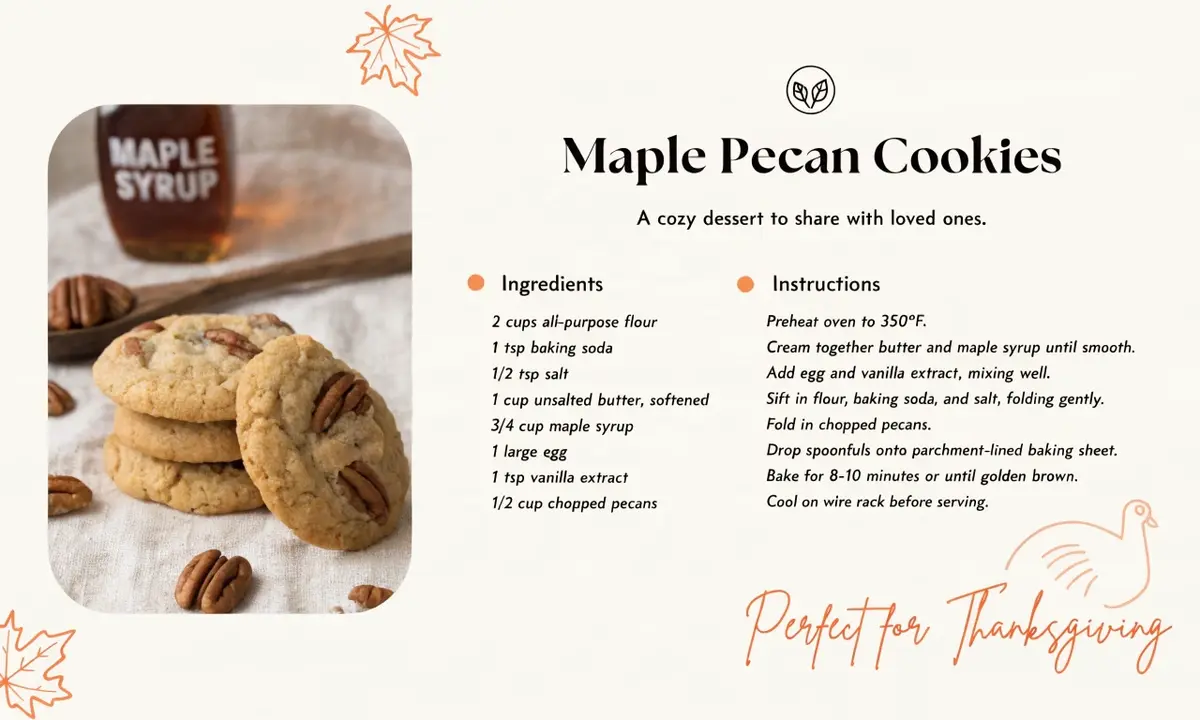
Maple and pecan are Thanksgiving’s two most distinctly American flavors. Maple syrup has been harvested in North America for centuries — it predates European settlement, developed by Indigenous peoples long before the first Thanksgiving took place. Pecans are native to the Mississippi River Valley and have been part of Southern and Midwestern cooking since before the United States existed. Together they form a combination that is not only delicious but genuinely rooted in the culinary history of the season.
In cookie form, this pairing captures everything that makes pecan pie so compelling — the toasted nut richness, the deep amber sweetness of good maple syrup, the slight bitterness that prevents the whole thing from reading as cloying — without requiring any of the pastry skill that pie demands. A thick, chewy brown butter cookie with toasted pecans throughout, finished with a maple cream cheese glaze and a whole toasted pecan pressed into the top, is one of the most naturally Thanksgiving-appropriate baked goods you can put on a dessert table.
This article is part of the seasonal cookie flavors guide. For the full fall baking lineup, see the pumpkin spice cookies, apple cinnamon cookies, and caramel apple cookies already live in this cluster.
Use real maple syrup — not extract, not pancake syrup
Pure maple syrup contains over 300 flavor compounds developed during the tree-sap evaporation process — vanillin, furanones, and dozens of caramel-like aromatics that no synthetic extract replicates. Maple extract is a single-compound approximation. Pancake syrup is corn syrup with artificial maple flavor. For a cookie where maple is the primary flavor, real maple syrup is non-negotiable. Use Grade A Dark Color / Robust Flavor (formerly Grade B) for the most intense, complex maple flavor in baked goods.
Maple Syrup Grades: Which One to Buy for Baking
The US and Canada standardized maple syrup grading in 2015. All commercially sold maple syrup is now Grade A, differentiated by color and flavor intensity:
| Grade | Color | Flavor | Best use |
|---|---|---|---|
| Grade A Golden / Delicate | Pale gold | Light, subtle, floral — barely maple | Drizzling over pancakes; too subtle for baking |
| Grade A Amber / Rich | Medium amber | Classic maple flavor — balanced and sweet | Good for baking; familiar maple taste |
| Grade A Dark / Robust ✓ | Dark amber | Intense, complex, caramel-forward — stands up to baking heat | Best for cookies, cakes, glazes — recommended here |
| Grade A Very Dark / Strong | Very dark | Very intense, almost molasses-like | Specialty baking; can overpower delicate recipes |
According to Serious Eats’ maple syrup grade guide, the dark and robust grade is the standard recommendation for baking because the Maillard reaction and caramelization that occur during baking diminish lighter flavor compounds more than heavier ones — meaning a subtle golden syrup loses most of what makes it interesting in the oven, while a dark robust syrup retains its character even after 12 minutes at 375°F.
Toasting Pecans: Non-Negotiable
Raw pecans have a mild, slightly waxy flavor and a soft texture that becomes lost inside a cookie dough. Toasted pecans have a deeply nutty, complex flavor from the Maillard reaction and a crisp, snappy texture that holds up against the soft cookie crumb and provides meaningful textural contrast. The difference between a raw pecan cookie and a toasted pecan cookie is not subtle — it is the difference between a background note and a flavor that earns its place in the recipe.
King Arthur Baking’s nut toasting guide recommends toasting pecans at 325°F / 165°C for 8–10 minutes, stirring once halfway through. The lower temperature relative to the oven’s baking setting prevents the outer surface from scorching before the interior develops flavor. Watch closely from 7 minutes onward — pecans go from perfectly toasted to burnt in under 2 minutes, and burnt pecans are intensely bitter and cannot be rescued.
The visual cue for correctly toasted pecans: they deepen from their raw beige color to a warm golden brown, and the kitchen fills with a distinctly nutty aroma. Remove from the oven immediately when this happens and spread on a cool baking sheet to stop the cooking process. Pecans continue to cook briefly from residual heat even after leaving the oven.
The Recipe
Ingredients — Makes 12–14 large cookies
Cookie dough
- 225g (1 cup / 2 sticks) unsalted butter, browned and cooled
- 160g (¾ cup) dark brown sugar, packed
- 60ml (¼ cup) Grade A Dark maple syrup
- 50g (¼ cup) granulated sugar
- 1 large egg + 1 egg yolk, room temperature
- 2 tsp pure vanilla extract
- ½ tsp maple extract (optional — amplifies maple flavor)
- 330g (2¾ cups) all-purpose flour
- 1 tsp baking soda
- ½ tsp baking powder
- ¾ tsp fine sea salt
- 1 tsp ground cinnamon
- ¼ tsp ground nutmeg
- 160g (1½ cups) toasted pecans, roughly chopped
Maple cream cheese glaze
- 115g (4 oz) full-fat block cream cheese, room temp
- 240g (2 cups) powdered sugar, sifted
- 3 tbsp Grade A Dark maple syrup
- 1–2 tbsp heavy cream (for consistency)
- Pinch fine sea salt
Garnish
- 12–14 toasted pecan halves (one per cookie)
- Flaky sea salt
- Optional: maple sugar sprinkle or turbinado sugar
Method
1-Toast the pecans
Preheat oven to 325°F / 165°C. Spread pecan halves in a single layer on a rimmed baking sheet. Toast 8–10 minutes, stirring once at the 5-minute mark, until fragrant and deepened in color. Remove immediately and transfer to a cool surface. Reserve 12–14 perfect pecan halves for garnish. Roughly chop the remainder into pieces approximately the size of a pea — not too fine (loses textural impact) and not too large (creates structural problems in the cookie). Cool completely before adding to dough.
2-Brown the butter and cool
Melt butter in a light-colored saucepan over medium heat, stirring frequently. Cook 4–6 minutes until milk solids are golden and the aroma is nutty. Pour into a large mixing bowl and cool to room temperature, approximately 30 minutes. Brown butter and toasted pecans together form one of the most harmonious flavor pairings in fall baking — both develop their complexity through the same Maillard reaction, which makes them taste as though they belong together.
3-Combine wet ingredients
Whisk cooled brown butter with dark brown sugar, maple syrup, and granulated sugar until smooth and combined. Add the egg, egg yolk, vanilla extract, and optional maple extract. Whisk vigorously for 1–2 minutes until the mixture lightens slightly in color and the sugars are fully incorporated. The maple syrup adds significant liquid at this stage — the dough will look looser than a standard cookie dough. This is correct and will be controlled by the flour addition and chilling.
4-Add dry ingredients and pecans
Whisk flour, baking soda, baking powder, salt, cinnamon, and nutmeg together. Add to the wet mixture all at once and fold with a rubber spatula until just combined — no dry streaks. Fold in the chopped toasted pecans. The dough will be soft and slightly sticky. Do not overmix — once the pecans are evenly distributed, stop folding.
5-Chill — minimum 2 hours, overnight preferred
Cover tightly and refrigerate for at least 2 hours. The maple syrup adds more liquid than most cookie recipes include, making thorough chilling essential for shape retention. Overnight chilling is strongly recommended — the maple flavor deepens and the brown butter and pecan notes meld into a more complex, unified profile. The dough firms considerably during an overnight rest and becomes easy to scoop cleanly.
6-Scoop, press, and bake
Preheat oven to 375°F / 190°C — verify with an oven thermometer. Line baking sheets with parchment. Using a #16 disher scoop, portion dough into balls (approximately 65g each). Place 6 per half-sheet pan. Press each ball into a disc about 2cm thick. Bake 11–13 minutes until the edges look set and the surface is matte — the pecan pieces will look deeply toasted and the cookie will have a warm amber color from the brown butter and maple syrup. The center should look slightly underdone. Pan-rest 10 minutes before moving.
7-Make the maple cream cheese glaze and finish
Beat cream cheese until smooth. Add sifted powdered sugar in two additions, beating on low between each. Add maple syrup and salt. Add heavy cream one tablespoon at a time until the glaze is thick but pourable — it should hold its shape briefly after being drizzled from a spoon before slowly spreading. Spoon approximately 2 tablespoons of glaze onto each fully cooled cookie and spread to the edges. Press one reserved toasted pecan half into the center of each glazed cookie before the glaze sets. Finish with a pinch of flaky sea salt and optional maple sugar or turbinado sugar sprinkle.
Why Brown Butter and Maple Syrup Work So Well Together
The combination of brown butter and maple syrup is one of the most synergistic flavor pairings in fall baking — and the reason is chemical. Both develop their complex flavor profiles through the same fundamental process: the Maillard reaction.
When butter is browned, the milk solids undergo Maillard reactions that produce furanones, pyrazines, and dozens of other aromatic compounds responsible for the nutty, caramel-like character. When maple sap is concentrated into syrup over heat, similar Maillard-derived compounds form — including many of the same furanones present in brown butter. The result is that maple syrup and brown butter share aromatic “vocabulary,” which is why their combination tastes harmonious rather than competing. Each amplifies what is already present in the other.
Add toasted pecans — which also develop Maillard compounds during their toasting — and you have three ingredients whose flavors are created by the same chemical process, producing a cookie that tastes seamlessly unified rather than like individual parts assembled together.
Maple Cream Cheese Glaze vs. Full Cream Cheese Frosting
This recipe uses a cream cheese glaze — thinner than a full piped frosting — rather than a thick swirl. The decision is intentional and specific to this flavor combination.
A thick cream cheese frosting would dominate the maple and pecan flavors beneath it — the cookie is already rich with brown butter and nuts, and a heavy frosting layer pushes the overall sweetness and dairy richness past the point where the individual components read clearly. The glaze, which is thinner and sets to a slight sheen rather than a thick topping, adds the cream cheese tang and maple sweetness as a complement without obscuring the cookie itself.
If you prefer a thicker frosting — or are making these for a context where visual drama matters more than flavor balance — use the full cream cheese frosting from the pumpkin spice cookie recipe with the addition of 3 tablespoons of maple syrup and a reduction in powdered sugar by 60g to compensate for the added liquid.
Thanksgiving dessert table strategy
Maple pecan cookies sit naturally alongside a Thanksgiving dessert spread without competing with the pies — they offer the pecan-maple flavor profile of pecan pie in a form that is easier to eat while standing, requires no serving utensils, and travels without the fragility of a pie. Make them the day before and refrigerate glazed. Remove from the refrigerator 30 minutes before serving to take the chill off. They hold at room temperature on a serving platter for up to 3 hours without the glaze weeping.
Variations Worth Trying
Maple bourbon pecan
Add 2 tablespoons of good bourbon to the wet ingredients alongside the maple syrup. The vanilla, oak, and caramel notes in bourbon amplify the brown butter and maple combination significantly — the trio is one of the great flavor combinations in American fall cooking. Reduce the heavy cream in the glaze by the same amount and substitute bourbon for a “bourbon maple glaze.” Clearly label these for adult gatherings.
Maple walnut (pecan alternative)
Substitute toasted walnuts for pecans at the same weight. Walnuts have a slightly more bitter, earthy flavor than pecans and a softer texture when baked into a cookie. The maple-walnut combination is a New England classic — more rustic and less sweet-forward than maple-pecan. The walnut bitterness provides an interesting contrast to the sweet glaze that the milder pecan does not.
Maple pecan chocolate chip
Fold 100g of dark chocolate chips (70% cacao) into the dough alongside the pecans. Dark chocolate’s slight bitterness and its own Maillard-derived flavor compounds play naturally alongside the maple and brown butter. Skip the glaze and finish with a dark chocolate drizzle and flaky salt instead — a dressier, more dramatic presentation that suits a dinner party context more than a casual Thanksgiving spread.
Maple pecan oatmeal
Replace 60g of the all-purpose flour with 60g of old-fashioned rolled oats. The oats add a hearty, slightly chewy texture that echoes the granola-and-maple-syrup flavor association many people have with fall breakfast foods. They also make the cookie slightly more substantial — useful if you want something that holds up as a standalone treat rather than a dessert alongside other sweets. The maple and pecan flavors are amplified by the oat base rather than muted.
Troubleshooting
| Problem | Likely cause | Fix |
|---|---|---|
| Cookies spread flat | Maple syrup adds extra liquid; dough not chilled enough | Chill minimum 2 hours; refrigerate shaped balls 10 min before each tray |
| Maple flavor too faint after baking | Light-grade maple syrup used; no overnight dough rest | Use Grade A Dark / Robust; chill overnight; add ½ tsp maple extract to dough |
| Pecans burn during baking | Pecan pieces too small; pieces on cookie surface exposed to direct heat | Keep pieces pea-sized minimum; press surface pecans lightly into dough before baking |
| Glaze too thin / runs off | Too much cream or maple syrup; applied to warm cookie | Add powdered sugar to thicken; apply only to fully cooled cookies |
| Dough too sticky to scoop | Maple syrup + insufficient chilling | Extend chill to 4+ hours; use disher scoop and work in batches from fridge |
Storage Guide
🗓️-Dough
Fridge: up to 72 hrs
Freezer: 3 months
Bake from frozen +3 min
🍪-Baked, unglazed
Room temp: 5 days
Freezer: 3 months
Glaze after thawing
✨-Glazed
Fridge: 5 days
Room temp: 2–3 hrs max
Glaze sets firm in fridge
Frequently Asked Questions
Can I substitute honey for maple syrup?
Honey works as a structural substitute at the same volume, but it produces a distinctly different cookie. Honey’s flavor is floral and its sweetness profile is different from maple’s caramel-molasses character. The result will be a good cookie — honey-pecan is itself a classic Southern flavor combination — but it will not taste like maple pecan. If using honey, raw or lightly processed varieties with more flavor complexity (buckwheat honey, tupelo honey, or raw wildflower honey) produce better results than standard commercial honey, which is mild to the point of near-neutrality in baked goods.
Do I have to use both egg and egg yolk?
The whole egg plus extra yolk combination is deliberate. The whole egg provides structure and moisture; the extra yolk adds fat and richness that balances the sweetness of the maple syrup and produces a slightly denser, chewier crumb. You can use 2 whole eggs instead — the cookie will be slightly lighter and less chewy, which is an acceptable tradeoff. Using only yolks (no whites) would produce a very soft, dense result that doesn’t hold up well as a large-format cookie.
Can I make these ahead for Thanksgiving?
Yes — this is one of the best make-ahead cookies in the fall cluster. Bake unglazed cookies up to 3 days ahead and store at room temperature in an airtight container. Make the glaze on the day of serving and apply 1–2 hours before the meal, allowing time for the glaze to set slightly. The whole pecan garnish can be pressed in immediately after glazing. This approach means no baking day-of, and the cookies arrive on the table fresh and properly glazed without any last-minute effort.
How do I keep the pecan halves on top from falling off?
Press the pecan half into the glaze within the first 5 minutes of glazing the cookie, before the cream cheese glaze begins to set. Apply gentle but firm pressure so the pecan sinks about a third of the way into the glaze. Once the glaze sets (30–45 minutes at room temperature, or 15 minutes in the refrigerator), the pecan is anchored in place and will not dislodge during handling or transport.
Continue reading — Seasonal Cookie Flavors
Leave a Reply