
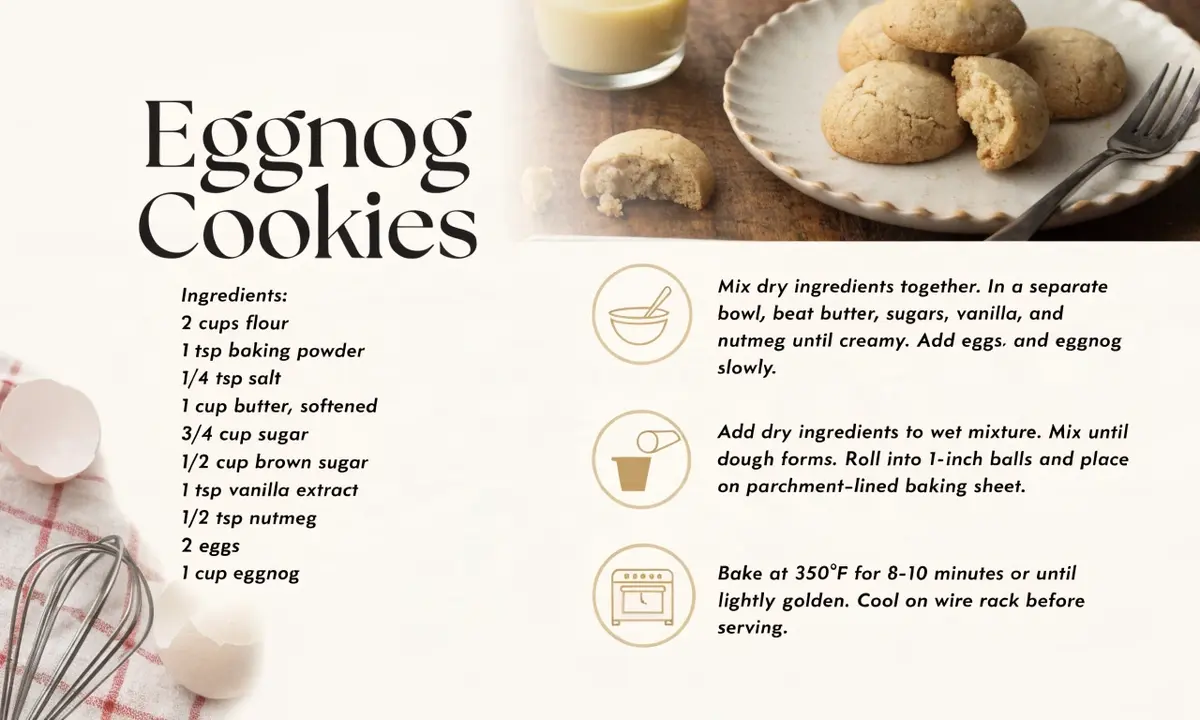
Eggnog is one of the most polarizing holiday flavors — people either love it immediately or have never understood the appeal. But translated into a thick, soft cookie with a nutmeg glaze, it tends to win over even the skeptics. The cookie captures what is actually good about eggnog — the rich custard warmth, the fragrant nutmeg, the subtle boozy depth — while leaving behind what puts people off about the drink itself (the viscous texture, the heaviness).
The flavor profile of eggnog translates to baked goods through three specific ingredients: extra egg yolks for the custard-like richness, freshly grated nutmeg as the defining spice, and a small amount of rum extract or bourbon for the warmth that distinguishes eggnog from plain vanilla. Together they produce a cookie that tastes unmistakably of the holiday drink without requiring any actual eggnog in the dough itself — though the glaze does use store-bought eggnog as its liquid component for an additional flavor hit.
This article is part of the seasonal cookie flavors guide. For the full holiday cookie picture, see our 10 gourmet Christmas cookie flavors overview, which places this recipe in context alongside the other December classics.
The three ingredients that make it taste like eggnog
Extra egg yolks — the fat and richness that give eggnog its custard character · Fresh whole nutmeg — grated immediately before use; the defining eggnog spice · Rum extract or bourbon — the boozy warmth that makes eggnog taste like a celebration rather than a glass of warm milk
The Recipe
Ingredients — Makes 10–12 large cookies
Cookie dough
- 225g (1 cup / 2 sticks) unsalted butter, softened
- 200g (1 cup) granulated sugar
- 100g (½ cup) dark brown sugar, packed
- 1 large egg, room temperature
- 3 large egg yolks, room temperature
- 2 tsp pure vanilla extract
- 1½ tsp rum extract or 2 tbsp good bourbon
- 360g (3 cups) all-purpose flour
- 1 tsp baking powder
- ½ tsp baking soda
- ¾ tsp fine sea salt
- 1½ tsp freshly grated whole nutmeg
- ½ tsp ground cinnamon
- ¼ tsp ground cloves
Eggnog nutmeg glaze
- 240g (2 cups) powdered sugar, sifted
- 3–4 tbsp store-bought eggnog (full-fat)
- ¼ tsp rum extract or 1 tsp bourbon
- Freshly grated nutmeg for finishing
- Pinch of fine sea salt
Optional: cream cheese frosting version
- 225g (8 oz) full-fat block cream cheese, cool
- 115g (½ cup) unsalted butter, cool room temp
- 360g (3 cups) powdered sugar, sifted
- 1 tsp vanilla extract + ¼ tsp nutmeg
Method
1-Cream butter and sugars
Beat softened butter with both sugars on medium-high speed for 3–4 minutes until pale, light, and significantly increased in volume. This is the primary aeration step for this dough — the extra egg yolks (which follow) add richness rather than lift, so the creaming phase is responsible for the cookie’s height. Do not rush it.
2-Add egg, yolks, vanilla, and rum
Add the whole egg first and beat on medium for 30 seconds. Add the three egg yolks one at a time, beating 20 seconds between each and scraping the bowl. The dough will look slightly curdled after the yolks — this is normal and will smooth out once the flour is added. Add vanilla extract and rum extract (or bourbon) and beat briefly to combine.
3-Add dry ingredients
Whisk together flour, baking powder, baking soda, salt, freshly grated nutmeg, cinnamon, and cloves. Add all at once to the butter mixture and fold with a rubber spatula until just combined — no dry streaks, but do not overmix. The dough will be soft and slightly tacky. This is correct; it firms during chilling.
4-Chill — minimum 2 hours, ideally overnight
Cover tightly and refrigerate for at least 2 hours. The extra egg yolks make this dough significantly softer than a standard cookie dough, and it requires a thorough chill to hold its shape during baking. Overnight chilling is recommended — the rum and nutmeg flavors deepen considerably with rest. The dough can be refrigerated up to 72 hours before baking.
5-Scoop, press, and bake
Preheat oven to 350°F / 175°C — verify with an oven thermometer. Line baking sheets with parchment. Using a #16 disher scoop, portion dough into balls (approximately 65g each). Place 6 per half-sheet pan. Press each ball into a disc about 2cm thick. If the dough has softened during scooping, re-chill shaped balls on the pan for 10 minutes before baking. Bake 11–13 minutes until edges are set and the surface looks matte but the centre still appears slightly underdone. Rest on the pan for 10 minutes before transferring to a wire rack to cool completely.
6-Make and apply the eggnog glaze
Whisk together sifted powdered sugar, 3 tablespoons of eggnog, rum extract, and salt until smooth. The glaze should be thick enough to coat the back of a spoon but thin enough to spread easily — adjust with additional eggnog (to thin) or powdered sugar (to thicken) one teaspoon at a time. Spoon approximately 1½ tablespoons of glaze onto each cooled cookie and spread to the edges with the back of the spoon or a small offset spatula. Immediately grate fresh nutmeg over the wet glaze so it adheres. Let set at room temperature for 30 minutes before stacking or storing.
Fresh Nutmeg vs. Pre-Ground: Why It Matters More Here Than Anywhere
In most cookie recipes, the difference between fresh-ground and pre-ground spices is significant but not critical. In an eggnog cookie, where nutmeg is the defining flavor, it is the difference between a cookie that tastes like eggnog and one that tastes vaguely spiced. This is not an exaggeration.
Whole nutmeg contains aromatic essential oils — primarily myristicin, elemicin, and safrole — that begin oxidizing and volatilizing the moment the spice is ground. Pre-ground nutmeg has already lost a significant portion of these aromatic compounds by the time it reaches the jar in the store, and continues losing them throughout its shelf life. Serious Eats’ nutmeg freshness testing found that fresh-grated nutmeg produced a flavor profile described as “complex, floral, and warming” while pre-ground was described as “flat and musty” by tasters, even from a recently opened jar.
Whole nutmeg is inexpensive, available in most grocery stores alongside pre-ground spices, and keeps almost indefinitely. A standard microplane or the smallest holes on a box grater produces fine, fluffy grated nutmeg in seconds. For this recipe: buy whole, grate fresh, use immediately.
Why Three Extra Egg Yolks? The Custard Science
Standard cookie recipes use whole eggs, which contribute both protein (from the white) and fat (from the yolk). Adding extra yolks — without their accompanying whites — shifts the ratio dramatically toward fat and away from the structural protein that egg whites provide.
The practical effects of this shift are exactly what you want for an eggnog cookie:
- Richer flavor: Egg yolks carry fat-soluble flavor compounds. A dough with more yolks tastes richer and more complex — closer to custard or crème brûlée than a plain butter cookie.
- Denser, fudgier crumb: Less protein from egg whites means less structure development during baking. The cookie sets more softly and stays soft longer — the interior crumb is closer to a thick pudding cookie than a standard chewy cookie.
- Deeper golden color: The carotenoids in egg yolks deepen the baked color of the cookie, producing a warm ivory-gold that visually reinforces the custard flavor cues.
- Longer shelf life: The higher fat content from the extra yolks helps the cookie retain moisture longer after baking. An eggnog cookie made with extra yolks is typically still soft and excellent on day four or five.
According to King Arthur Baking’s deep dive into egg function in baking, replacing one whole egg with two yolks in a cookie recipe produces a noticeably chewier, richer result — and the effect compounds with each additional yolk. Three extra yolks in this recipe (beyond the one whole egg) is an assertive choice that produces an assertively eggnog-like result.
Rum Extract vs. Real Bourbon: Which to Use
Both work, but they produce different flavor profiles and are appropriate for different contexts:
Rum Extract (1½ tsp)
Produces a cleaner, more concentrated rum note. Alcohol bakes off completely — cookies are fully non-alcoholic. Better choice when serving children or guests who don’t consume alcohol. The flavor reads as “classic eggnog” — familiar and crowd-pleasing.
Best for: family gatherings, children present, broad audience
Good Bourbon (2 tbsp)
Adds vanilla, oak, and caramel undertones alongside the boozy warmth. Most alcohol bakes off, but trace amounts remain. The flavor is more complex and adult — less “eggnog” and more “spiked eggnog.” Use a bourbon you enjoy drinking; cheap bourbon tastes cheap in baked goods too.
Best for: adult gatherings, holiday parties, gifts to adults
For the glaze, the same logic applies — use rum extract for a cleaner flavor, or replace the eggnog liquid partially with a tablespoon of actual bourbon for adults. A tablespoon of bourbon in a glaze spread across 10–12 cookies amounts to a negligible quantity of alcohol per cookie, but the flavor contribution is meaningful.
Glaze vs. Cream Cheese Frosting: Which Topping to Choose
This recipe offers two topping options, and the choice affects both flavor and presentation significantly.
The eggnog glaze is thinner, sets to a light sheen, and lets the cookie’s natural color show through. It reinforces the eggnog flavor directly (using actual eggnog as the liquid) and finishes with a grated nutmeg garnish that makes the cookie visually unmistakable. It is the simpler preparation and the more elegant finish. The cookie reads as a glazed holiday confection rather than a frosted bakery item.
The cream cheese frosting is thicker, more indulgent, and creates the visual drama of a Crumbl-style swirled topping. It adds tangy richness that contrasts the sweet, custard-forward cookie. The nutmeg in the frosting carries through the eggnog flavor profile. This version is richer and more filling — better suited to a dessert plate than a cookie tray where people will eat multiples.
General guidance: use the glaze for cookie trays, gifting, and contexts where people will eat one or two cookies. Use the cream cheese frosting when this is the only cookie being served or for a more restaurant-dessert presentation.
Getting the glaze consistency right
The glaze should be thick enough that it mounds slightly on the cookie before spreading — if it immediately runs off the edge, it is too thin and the layer will be too sheer to carry flavor. If it does not spread at all, it is too thick and will set with a lumpy surface. The target: a ribbon of glaze dropped from a spoon should hold its shape for 2–3 seconds before melting back into the bowl. Adjust with eggnog (to thin) or powdered sugar (to thicken) one teaspoon at a time.
Variations Worth Trying
Spiked eggnog sandwich cookies
Bake slightly smaller cookies using a #20 scoop, and sandwich two together with a generous layer of bourbon-spiked cream cheese frosting. The resulting sandwich cookie is closer in size to a standard large cookie but dramatically more impressive in cross-section — the thick, ivory frosting layer is visible from the side. Dust the top with freshly grated nutmeg and a pinch of cinnamon sugar.
White chocolate chip eggnog cookies
Fold 150g of quality white chocolate chips or chopped white chocolate bar into the dough before chilling. The creamy sweetness of white chocolate amplifies the custard character of the extra egg yolks and pairs naturally with nutmeg. Finish with the eggnog glaze rather than cream cheese frosting — the layered sweet-on-sweet needs the glaze’s restraint rather than the frosting’s richness.
Vegan eggnog cookies
Replace whole egg and yolks with 3 tablespoons of full-fat coconut cream plus 1 flax egg (1 tbsp ground flaxseed + 3 tbsp water, rested 5 minutes). Replace butter with vegan stick butter. Use plant-based eggnog (Silk, So Delicious, and Califia all make seasonal versions) in the glaze. The coconut cream approximates the fat content of the egg yolks reasonably well; the cookies will be slightly less rich but still distinctly eggnog-flavored. Omit the rum extract or use a small amount of vanilla bean paste for a non-alcoholic flavor depth.
Troubleshooting
| Problem | Likely cause | Fix |
|---|---|---|
| Cookies spread flat | Extra yolks make dough very soft; insufficient chilling | Chill minimum 2 hours; refrigerate shaped balls 10 min before each tray |
| Dough too sticky to scoop | Normal with extra yolks — needs longer chill | Extend chill to 4+ hours; use a disher scoop (not hands) to portion |
| Nutmeg flavor too faint | Pre-ground nutmeg used; old spices | Always use whole nutmeg grated fresh; add extra grated nutmeg to glaze |
| Glaze too runny | Eggnog added too quickly or in excess | Add eggnog 1 tsp at a time; add powdered sugar to thicken if needed |
| Cookie tastes bland / not like eggnog | Insufficient rum extract, pre-ground nutmeg, skipped overnight rest | Increase rum extract by ½ tsp; use fresh-grated nutmeg; chill dough overnight |
Storage Guide
🗓️
Dough
Fridge: up to 72 hrs
Freezer: 3 months
Bake from frozen +4 min
🍪
Baked, unglazed
Room temp: 5–7 days
Freezer: 3 months
Extra yolks = stays soft longer
✨
Glazed
Room temp: 3–4 days
Fridge: 5 days
Glaze sets fully in 1 hr
Frequently Asked Questions
Can I use actual eggnog in the cookie dough itself?
You can substitute 2–3 tablespoons of store-bought eggnog for the vanilla extract and reduce the rum extract by half. The eggnog adds additional flavor reinforcement and a small amount of liquid. However, the nutmeg and rum extract in the dough already produce a more concentrated eggnog flavor than adding the actual drink — eggnog is mostly milk and sugar, and those components don’t contribute much flavor distinction in a baked good beyond what butter and sugar already provide.
Is this recipe safe to eat raw?
The dough contains both whole egg and raw egg yolks, which carry a small risk of Salmonella. If you want to taste the raw dough safely, heat-treat the flour first (microwave in 30-second bursts until it reaches 165°F / 74°C throughout) and use pasteurized eggs. For a true raw eggnog cookie dough experience — the kind served as an edible dessert — follow those two steps and the flavor is excellent.
What if I can’t find whole nutmeg?
Whole nutmeg is widely available in the spice aisle of most grocery stores, often alongside the pre-ground version. If you genuinely cannot find it, use freshly-opened pre-ground nutmeg and increase the quantity to 2 teaspoons in the dough and add extra to the glaze. The flavor will be less vivid, but the cookie will still work. After making this recipe once, buying a bag of whole nutmeg for future use is worth it — a single whole nutmeg grated finely produces roughly 2–3 teaspoons of ground nutmeg and costs pennies.
How do I know when the cookies are done if I can’t judge by color?
The visual cues for this recipe: edges should be set and slightly pulling away from the pan, and the top surface should look matte rather than wet or shiny. The center will still look underdone — slightly puffy and soft. Press the center gently with a fingertip; it should yield but spring back slightly rather than collapsing. At 11 minutes, check these cues and pull when they’re met — do not rely on time alone. An oven thermometer is essential; as our equipment guide explains, most home ovens run significantly off their stated temperature, which changes baking time considerably.
Continue reading — Seasonal Cookie Flavors
Leave a Reply